Event submissions
Published
This submission belongs to the session S1. Mental Health of the event The 1st International Online Conference on Children's Health
Published date
12 Nov, 2026
Academic Editor
 Valentina Lucia La Rosa
Citation
Humphrey Masimba Makumbirofa, VANESSA DANAI BEREJENA, A Multifaceted Approach to Pediatric HIV Management: Integrating Innovative Therapies and Adherence Support to Improve Mental Health and Quality of Life, in Proceedings of The 1st International Online Conference on Children's Health, 17 November–19 November 2026, MDPI: Basel, Switzerland
Share
Email
Facebook
Twitter
LinkedIn
A Multifaceted Approach to Pediatric HIV Management: Integrating Innovative Therapies and Adherence Support to Improve Mental Health and Quality of Life

Humphrey Masimba Makumbirofa 1

VANESSA DANAI BEREJENA 2
1. Department of Pharmaceutical Technology, School of Allied Health Sciences, Harare Institute of Technology, Harare, Zimbabwe
2. Dispensary Department, Trinity Pharmacy, Harare, Zimbabwe
Abstract
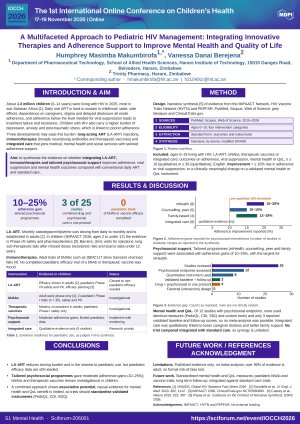
Background: Children living with HIV experience persistent health disparities, poor antiretroviral therapy (ART) adherence, and diminished quality of life (QoL). Psychosocial challenges, including stigma, daily medication burden, and limited mental health support, are key drivers of these poor outcomes. Objective: This narrative synthesis asks the following: does integration of long-acting ART (LA-ART), immunotherapies, and tailored psychosocial support improve adherence, viral suppression, and mental health outcomes compared to conventional daily ART with standard care? Methods: We synthesised evidence from major paediatric HIV initiatives, including the IMPAACT Network, HIV Vaccine Trials Network (HVTN), and PEPFAR. We examined LA-ART formulations, broadly neutralising antibodies (bNAbs), therapeutic vaccines, and integrated care models combining medical, mental health, and social services with tailored adherence programmes (mHealth, counselling). Results: IMPAACT trials indicate LA-ART (cabotegravir/rilpivirine) improves adherence and viral suppression by reducing dosing from daily to monthly. PEPFAR-supported tailored adherence programmes were consistently associated with moderate adherence gains (10–25% increase across studies). Early-phase bNAb and therapeutic vaccine trials show promise for passive immunity and viral reservoir reduction, though paediatric efficacy data remain scarce. Regarding psychosocial outcomes, integrated care models were qualitatively associated with reduced caregiver-reported distress and improved family support; however, quantitative mental health and QoL measures were reported inconsistently across the limited subset of studies assessing these endpoints, preventing formal meta-analysis. Conclusions: A multifaceted approach combining pharmacological innovation with holistic psychosocial support shows associative potential to improve paediatric HIV outcomes. However, direct causal evidence for mental health and QoL benefits remains limited by heterogeneous measures, scarce paediatric bNAb/vaccine data, and an absence of long-term studies. We recommend that future trials standardise the collection of validated mental health and QoL instruments to generate the robust evidence needed to inform holistic paediatric HIV care guidelines.
Keywords
pediatric HIV
long-acting antiretroviral therapy
broadly neutralising antibodies
mental health
adherence
integrated care model
quality of life
Poster
Pediatric HIV Multifaceted Poster.pdf
Detecting Risk vs. Change: An Evaluation of the Seek Screen's Use in the HealthySteps Model
Parental Factors Associated with Mental Health, Prosociality, and Academic Performance in Adolescence: An Exploratory Study in Families from Spain and Colombia.