Event submissions
Published
This submission belongs to the session S1. Mental Health of the event The 1st International Online Conference on Children's Health
Published date
12 Nov, 2026
Academic Editor
 Valentina Lucia La Rosa
Citation
Intan Rofi'ah, Dian Kurniasari, Amin Sulistiyowati, Ashari Dian Pratiwi, Profiles of Mathematics Anxiety in an Inclusive Elementary Classroom: Behavioral, Cognitive, and Affective Manifestations among Students with and without Special Educational Needs, in Proceedings of The 1st International Online Conference on Children's Health, 17 November–19 November 2026, MDPI: Basel, Switzerland
Share
Email
Facebook
Twitter
LinkedIn
Profiles of Mathematics Anxiety in an Inclusive Elementary Classroom: Behavioral, Cognitive, and Affective Manifestations among Students with and without Special Educational Needs

Intan Rofi'ah 1
Dian Kurniasari 1
Amin Sulistiyowati 2
Ashari Dian Pratiwi 3
1. Faculty of Science and Humanity, Tiga Serangkai University, Surakarta, Indonesia
2. Vocational School, Tiga Serangkai University, Surakarta, Indonesia
3. Faculty of Economics and Business, Universitas Sebelas Maret, Surakarta, Indonesia
Abstract
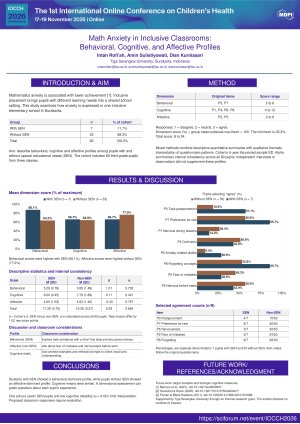
Mathematics anxiety can appear as observable avoidance, negative thoughts, and emotional distress. However, few studies have described how these manifestations are expressed by students who learn together in inclusive elementary classrooms. This study aimed to examine the profile of mathematics anxiety among students with and without special educational needs in one inclusive elementary school. A mixed-methods design was used by combining descriptive quantitative analysis with qualitative thematic interpretation. The participants were 60 third-grade students from Surakarta, Indonesia, consisting of 7 students with special educational needs and 53 students without special educational needs. Data were collected using an eight-item self-report mathematics anxiety scale covering three dimensions: behavioral, cognitive, and affective. The results showed that students with special educational needs had a behavioral-dominant profile, with the behavioral dimension reaching 88.1% of the maximum score. This profile was reflected in task avoidance, postponement, and reduced engagement in mathematics activities. Students without special educational needs showed an affective-dominant profile, with the affective dimension reaching 77.0% of the maximum score. Their anxiety appeared mainly as nervousness, fear of mistakes, and emotional discomfort before mathematics tasks. The cognitive dimension was relatively similar across both groups. These findings suggest that mathematics anxiety in inclusive classrooms should be identified through its specific manifestations, not only through total scores or student categories. Dimension-based identification can help teachers provide more responsive emotional and instructional support.
Keywords
mathematics anxiety
inclusive education
special educational needs
elementary students
behavioral anxiety
affective anxiety
cognitive anxiety
Poster
IOCCH2026_Poster_A0.pdf
The Association Between Deprivation, Mental Health and Repeat Attendance in Adolescents presenting to the Emergency Department: A UK retrospective Cohort Study
Living in the Shadows: A Qualitative Study on the Lived Experiences of Children with Xeroderma Pigmentosum and Their Mothers