Event submissions
Published
This submission belongs to the session S1. Mental Health of the event The 1st International Online Conference on Children's Health
Published date
12 Nov, 2026
Academic Editor
 Valentina Lucia La Rosa
Citation
Berkay Tayşi, Kardelen Tayşi, Kadir Atacan Yıldız, Tuğba Kevser Uzunçakmak, Zehra Koyuncu, Living in the Shadows: A Qualitative Study on the Lived Experiences of Children with Xeroderma Pigmentosum and Their Mothers, in Proceedings of The 1st International Online Conference on Children's Health, 17 November–19 November 2026, MDPI: Basel, Switzerland
Share
Email
Facebook
Twitter
LinkedIn
Living in the Shadows: A Qualitative Study on the Lived Experiences of Children with Xeroderma Pigmentosum and Their Mothers

Berkay Tayşi 1

Kardelen Tayşi 1
Kadir Atacan Yıldız 2
Tuğba Kevser Uzunçakmak 2
Zehra Koyuncu 1
1. Department of Child and Adolescent Psychiatry, Faculty of Medicine, Istanbul University Cerrahpaşa-Cerrahpaşa, İstanbul, Turkey (Türkiye)
2. Department of Dermatology and Venereology, Faculty of Medicine, Istanbul University Cerrahpaşa-Cerrahpaşa, İstanbul, Turkey (Türkiye)
Abstract
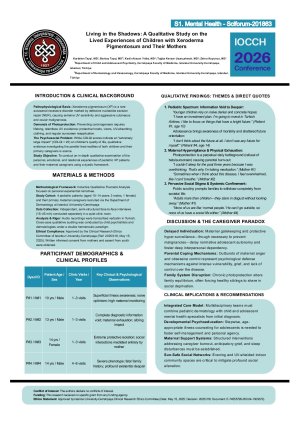
Introduction: Xeroderma Pigmentosum (XP), a rare genetic disorder, drastically increases the risk of skin cancer and neurological issues due to extreme UV sensitivity. While the medical and dermatological aspects of XP are thoroughly studied, the profound social and psychological effects on affected families remain critically under-researched. This qualitative study examines four pediatric patients with XP (aged 10–14) and their primary maternal caregivers to understand the deep psychological, emotional, and social adjustments that these families require.
Methods: Four pediatric patients and their primary maternal caregivers were interviewed using a qualitative design and semi-structured clinical interviews at a tertiary university hospital. To preserve semantic nuances and find shared meaning across individual accounts, inductive qualitative thematic analysis was meticulously applied to the verbatim transcripts.
Results: The thematic analysis revealed distinct interconnected themes, including profound emotional distress, limited child autonomy, chronic social isolation, and severely disrupted family dynamics. Pediatric participants often demonstrated a very limited or superficial understanding of their prognosis, leading to an extreme psychological dependence on parents. Caregivers described a pervasive state of chronic anxiety, mental fatigue, and the immense, non-stop burden of constant medical vigilance, alongside common feelings of abnormality, hyper-vigilance, and overprotection within the social environment.
Conclusions: Holistic, family-centered care models that systematically integrate emotional, psychiatric, and relational support with strict physical medical management are needed urgently. Improving the long-term quality of life and health expectations for children with XP and their families requires structured, age-appropriate clinical information, targeted psychotherapeutic interventions for caregivers, and safe, indoor peer interaction frameworks.
Keywords
Xeroderma Pigmentosum
social challenges
psychological impact
caregiver burden
quality of life
Qualitative Thematic Analysis
Poster
XP_A0.pdf
Profiles of Mathematics Anxiety in an Inclusive Elementary Classroom: Behavioral, Cognitive, and Affective Manifestations among Students with and without Special Educational Needs
The Buddy Bench as a participatory intervention for promoting children's well-being and peer inclusion: findings from an Italian pilot study