Event submissions
Published
This submission belongs to the session S1. Mental Health of the event The 1st International Online Conference on Children's Health
Published date
12 Nov, 2026
Academic Editor
 Valentina Lucia La Rosa
Citation
Chiara Cavallo, Valeria Cavioni, The Buddy Bench as a participatory intervention for promoting children's well-being and peer inclusion: findings from an Italian pilot study, in Proceedings of The 1st International Online Conference on Children's Health, 17 November–19 November 2026, MDPI: Basel, Switzerland
Share
Email
Facebook
Twitter
LinkedIn
The Buddy Bench as a participatory intervention for promoting children's well-being and peer inclusion: findings from an Italian pilot study

Chiara Cavallo 1,2

Valeria Cavioni 1
1. Department of Humanities and Social Sciences, Faculty of Society and Communication Sciences, Universitas Mercatorum, Rome, Italy
2. Comprehensive Institute of Moretta, “G. Rodari” Primary School, Carde’, Cuneo, Italy
Abstract
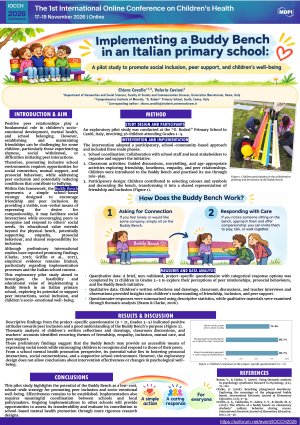
Background/Objectives: Positive peer relationships are a key protective factor for children's mental health, while loneliness and peer exclusion may negatively affect well-being and school belonging. The Buddy Bench provides children with a visible, non-verbal way to communicate a need for peer interaction. Despite its growing use, empirical evidence remains limited, particularly in Italy. This study explored the feasibility and educational value of implementing a Buddy Bench in an Italian primary school.
Methods: The study involved 36 children attending grades 1–5. Prior to the installation of the Buddy Bench, classroom-based activities promoted reflection on friendship, loneliness, and helping behaviours. Children participated in guided discussions, collaboratively developed shared rules for using the bench, and contributed to its design and decoration. Children completed a brief project-specific questionnaire with categorical response options exploring peer interactions and perceptions of the Buddy Bench initiative. Qualitative material included children's written reflections and drawings, classroom discussions, and teachers' reflective observations of the use of the Buddy Bench and its classroom adaptation.
Results: Descriptive findings showed that 71.4% of children would invite a peer who was alone to play, while 85.7% correctly identified the Buddy Bench as a means of signalling a need for peer connection and 85.7% would immediately approach a child using it. Thematic analysis of children's written and graphic productions, classroom discussions, and teachers' observations identified recurring themes of friendship, inclusion, empathy, mutual care, and peer support. The Buddy Bench emerged as a recognizable space for expressing social needs and facilitating peer interaction.
Conclusions: This pilot study provides initial evidence supporting the feasibility and acceptability of implementing a Buddy Bench in an Italian primary school. The participatory approach promoted children's engagement and shared responsibility for peer inclusion. The Buddy Bench may represent a low-cost and scalable universal strategy for supporting peer connection, social inclusion, and emotional well-being at school. Further research using validated measures and longitudinal designs is needed to evaluate its effectiveness.
Keywords
Buddy Bench
internalizing problems
loneliness
bullying prevention
social skills
Poster
IOCCH_Implementing a Buddy Bench.pdf
Living in the Shadows: A Qualitative Study on the Lived Experiences of Children with Xeroderma Pigmentosum and Their Mothers
Negative Birth Experiences, Postnatal Depression, and Disrupted Maternal-Infant Attachment: A Pathway Analysis of Child Developmental Risk in Ghana