Event submissions
Published
This submission belongs to the session S1. Mental Health of the event The 1st International Online Conference on Children's Health
Published date
12 Nov, 2026
Academic Editor
 Valentina Lucia La Rosa
Citation
H. Antonio Pineda-Espejel, Marina Trejo Trejo, Edgar Ismael Alarcón Meza, Laura González Rovira, Self-Concept and Intention to Be Physically Active in High School Students, in Proceedings of The 1st International Online Conference on Children's Health, 17 November–19 November 2026, MDPI: Basel, Switzerland
Share
Email
Facebook
Twitter
LinkedIn
Self-Concept and Intention to Be Physically Active in High School Students

H. Antonio Pineda-Espejel 1
Marina Trejo Trejo 1
Edgar Ismael Alarcón Meza 1
Laura González Rovira 1
1. Faculty of Sports, Mexicali Campus, Autonomous University of Baja California, Mexicali, 21100, Mexico
Abstract
Self-concept refers to the evaluation of individual qualities, attributes, and characteristics that are comparable to those of others. Physical activity has a positive impact on self-concept. Adolescents spend a significant amount of time at school; physical education can have benefits for their social, physical, and psychological development.
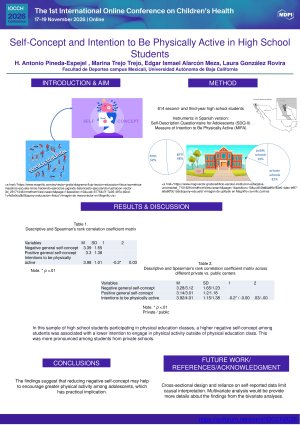
Method. A total of 614 second- and third-year high school students enrolled in physical education classes participated in the study. These students came from private (n = 497) and public (n = 115) schools in northern Mexico. Of these, 295 were boys and the rest were girls. During physical education class, the Self-Description Questionnaire for Adolescents (SDQ-II) and the Measure of Intention to Be Physically Active (MIFA) in its Spanish version were administered.
Results. Participants had moderate negative and positive general self-concepts (M=3.39, SD=1.55; M=3.30, SD=1.38, respectively), and moderately high intentions to be physically active (M=3.98, SD=1.01). The Kolmogorov-Smirnov test for normality of the data distribution showed that the variables deviated from normality (statistic between .071 and .15; p=.00), so bivariate correlation analysis was performed using Spearman's rank correlation coefficient. Negative general self-concept was negatively associated with the intention to be physically active outside of physical education class (ρ = -.15; p=.00), and this relationship was weak, while positive self-concept did not show a significant relationship (ρ = .03; p=.46). Furthermore, the relationship between negative self-concept and intention was only found to be significant for those studying in private schools (ρ = -.20; p=.00), not for those in public schools (ρ= -.001; p=.99).
Conclusion: In this sample of high school students participating in physical education classes, a higher negative self-concept among students was associated with a lower intention to engage in physical activity outside of physical education class. This was more pronounced among students from private schools.
Keywords
adolescents
physical education
correlation
physical activity
Poster
poster iocso 2026 child.pdf
Negative Birth Experiences, Postnatal Depression, and Disrupted Maternal-Infant Attachment: A Pathway Analysis of Child Developmental Risk in Ghana
Explainable AI for Adolescent Depression Screening: A MentalBERT-LIWC Fusion Approach