Event submissions
Published
This submission belongs to the session S1. Mental Health of the event The 1st International Online Conference on Children's Health
Published date
12 Nov, 2026
Academic Editor
 Valentina Lucia La Rosa
Citation
Komal Kumari, Rahul Jain, Explainable AI for Adolescent Depression Screening: A MentalBERT-LIWC Fusion Approach, in Proceedings of The 1st International Online Conference on Children's Health, 17 November–19 November 2026, MDPI: Basel, Switzerland
Share
Email
Facebook
Twitter
LinkedIn
Explainable AI for Adolescent Depression Screening: A MentalBERT-LIWC Fusion Approach

Komal Kumari 1
Rahul Jain 1
1. Department of Computer Engineering, Marwadi University, Rajkot, 360001, India
Abstract
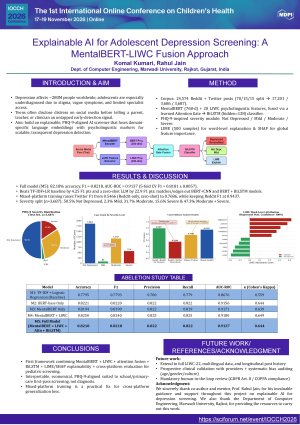
Depression is a frequent mental health issue in the lives of children and adolescents that can be overlooked and undiagnosed. Young people often display emotions and emotional responses online, and the social media landscape is providing a chance for big, automated screenings. In this work, we introduce an explainable deep learning approach, composed of MentalBERT, a domain-specific pre-trained language embedding and the psycholinguistic features extracted from Linguistic Inquiry and Word Count (LIWC).
Then, the two types of features are combined by an attention gate that is learned, while the attention gate output is classified by a Bidirectional Long Short-Term Memory (BiLSTM) network that models contextual relationships. A severity module based on the clinical instrument used in the PHQ-9 allows predictions to be classified into four severity levels, Not Depressed, Mild, Moderate, and Severe, which can be used to indicate clinically relevant triage. LIME is used to give word-level explanations, giving clinicians the added layer of transparency of being able to understand model predictions at the word level.
The model has been trained and tested on a corpus of 24,574 social media posts from Reddit and Twitter with a high accuracy of 82.18%, AUC-ROC of 0.9137 and macro F1-score of 0.8218. The model showed consistent and stable performance across the five-fold cross-validation, achieving an F1-score of 0.8181 ± 0.0057.
In general, this tool is economical and easily understood the early identification of depression in schools and primary care clinics worldwide and can aid in the early clinical intervention of adolescent depression
Keywords
Adolescent Depression
Pediatric Mental Health Screening
MentalBERT
Explainable AI
Psycholinguistic Features
Attention-Based Fusion
Severity Classification
Social Media Analysis
Poster
Poster_Presentation.pdf
Self-Concept and Intention to Be Physically Active in High School Students
Building a Family Navigation Matrix for Children with Autism: A Journey-Mapping Study