Event submissions
Published
This submission belongs to the session S2. Neonatology of the event The 1st International Online Conference on Children's Health
Published date
12 Nov, 2026
Academic Editor
 Lin Hungchih
Contribution&Funding
Conceptualization,
[Vasiliki Georgousopoulou] ; [Charikleia Orfanidou ] ; [Mirto Kalloniati] ; [Evangelia Charmandari]
Methodology,
[Evangelia Charmandari] ; [Vasiliki Georgousopoulou] ; [Mirto Kalloniati] ; [Georgios Manomenidis]
Software,
[Charikleia Orfanidou ]
Validation,
[Georgios Manomenidis] ; [Mirto Kalloniati] ; [Vasiliki Georgousopoulou] ; [Charikleia Orfanidou ]
Formal analysis,
[Georgios Manomenidis] ; [Vasiliki Georgousopoulou]
Investigation,
[Evangelia Charmandari]
Data curation,
[Mirto Kalloniati] ; [Charikleia Orfanidou ]
Writing - original draft,
[Mirto Kalloniati] ; [Charikleia Orfanidou ] ; [Georgios Manomenidis]
Writing - review,
[editing] ; [Evangelia Charmandari] ; [Vasiliki Georgousopoulou] ; [Charikleia Orfanidou ] ; [Georgios Manomenidis]
Supervision,
[Vasiliki Georgousopoulou]
Project administration,
[Vasiliki Georgousopoulou] ; [Evangelia Charmandari]
Funding: --
Citation
Mirto Kalloniati, Georgios Manomenidis, Evangelia Charmandari, Charikleia Orfanidou , Vasiliki Georgousopoulou, Artificial Intelligence for Detecting Pain in Neonates in the NICU: A Systematic Review of the Literature, in Proceedings of The 1st International Online Conference on Children's Health, 17 November–19 November 2026, MDPI: Basel, Switzerland
Share
Email
Facebook
Twitter
LinkedIn
Artificial Intelligence for Detecting Pain in Neonates in the NICU: A Systematic Review of the Literature

Mirto Kalloniati 1

Georgios Manomenidis 2

Evangelia Charmandari 3
Charikleia Orfanidou 2
Vasiliki Georgousopoulou 2
1. Department of Medicine, National and Kapodistrian University of Athens, Athens, 11157, Greece
2. Department of Nursing, Democritus University of Thrace, Alexandroupolis, 68100, Greece
3. Medical School, National and Kapodistrian University of Athens, Athens, 11157, Greece
Abstract
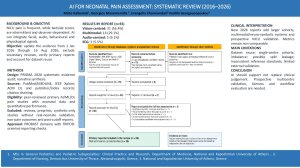
Background: Accurate neonatal pain assessment remains challenging because behavioural responses are subtle, physiological signals are nonspecific, and commonly used bedside scales are intermittent and observer-dependent. Artificial intelligence (AI) may enable continuous, objective assessment by integrating facial, vocal, behavioural, physiological and neurophysiological information.
Methods: We conducted an updated systematic evidence audit in accordance with PRISMA 2020. PubMed/MEDLINE, IEEE Xplore, ACM Digital Library, publisher and index records, and backward and forward citation searches were examined. Peer-reviewed primary studies evaluating AI, machine-learning or deep-learning approaches for neonatal pain and reporting quantitative performance were eligible. Reviews, preprints, synthetic-only studies without validation in real neonates, and studies addressing outcomes other than pain were excluded. Risk-of-bias domains and reporting completeness were evaluated using PROBAST- and TRIPOD-oriented criteria. Reports based on shared cohorts or benchmark datasets were linked to avoid treating repeated model publications as independent clinical replications.
Results: Seventy unique records were screened, 62 reports were sought for retrieval, 60 full texts were assessed, and 55 primary reports were included, representing 28 distinct study or dataset families. Thirteen included reports were published in 2026. Vision-centred methods predominated (31/55; 56.4%), followed by multimodal systems (16/55; 29.1%), audio-centred approaches (5/55; 9.1%) and EEG-based models (3/55; 5.5%). Recent studies included larger cohorts, multimodal and neuro-symbolic methods, and prospective NICU validation. However, comparison across studies was limited by heterogeneous pain definitions, reference standards, datasets and performance metrics. Recurrent concerns included single-centre samples, class imbalance, dataset reuse, potential split leakage and limited external validation.
Conclusion: AI shows promise as a supportive tool for neonatal pain recognition but is not ready to replace clinical judgement. Future research should prioritize prospective multicentre validation, transparent reporting, external testing, fairness assessment and evaluation of clinical workflow integration.
Keywords
artificial intelligence; neonatal pain; neonatal intensive care unit; machine learning; deep learning; nursing.
Poster
AI_Neonatal_Pain_Evidence__ePoster.pdf
Anorectal malformations among children with congenital heart defects: Prevalence and clinical profile from a large Indian paediatric cardiac cohort
Pregnancy Health Financing and Maternal–Newborn Survival: Financial Hardship, ANC Coverage and Neonatal Mortality