Event submissions
Published
This submission belongs to the session S2. Neonatology of the event The 1st International Online Conference on Children's Health
Published date
12 Nov, 2026
Academic Editor
 Lin Hungchih
Citation
Manya Mehra, Precision Respiratory Care in the NICU: Early Predictors of CPAP Failure in Preterm Neonates, in Proceedings of The 1st International Online Conference on Children's Health, 17 November–19 November 2026, MDPI: Basel, Switzerland
Share
Email
Facebook
Twitter
LinkedIn
Precision Respiratory Care in the NICU: Early Predictors of CPAP Failure in Preterm Neonates

Manya Mehra 1
1. Emergency Department, Azael Smart City Hospital, Jhansi, 284001, India
Abstract
Introduction:
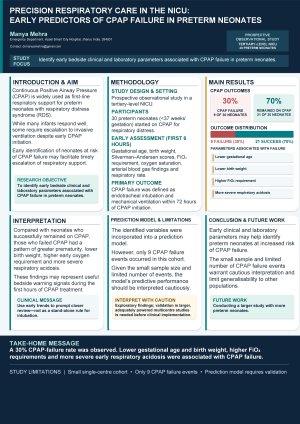
Continuous Positive Airway Pressure (CPAP) is widely used as first-line respiratory support for preterm neonates with respiratory distress syndrome (RDS). While many infants respond well, some require escalation to invasive ventilation despite early CPAP initiation. Early identification of neonates at risk of CPAP failure may facilitate timely escalation of respiratory support. This study aimed to identify early bedside clinical and laboratory parameters associated with CPAP failure in preterm neonates.
Methods:
A prospective observational study was conducted in a tertiary-level NICU including 30 preterm neonates (<37 weeks’ gestation) started on CPAP for respiratory distress. Clinical and laboratory parameters, including gestational age, birth weight, Silverman–Andersen scores, FiO₂ requirement, oxygen saturation, arterial blood gas findings, and respiratory rate, were recorded within the first six hours after CPAP initiation. CPAP failure was defined as the need for endotracheal intubation and mechanical ventilation within 72 hours of starting CPAP.
Results:
Nine neonates (30%) experienced CPAP failure. Compared with neonates who successfully remained on CPAP, those who failed CPAP had lower gestational age and birth weight, higher FiO₂ requirements, and more severe respiratory acidosis during the initial six hours after CPAP initiation. These variables were incorporated into a prediction model; however, given the small sample size and the limited number of CPAP failure events, the predictive performance of the model should be interpreted cautiously.
Conclusions:
Early clinical and laboratory parameters may help identify preterm neonates at increased risk of CPAP failure. However, the small sample size and the limited number of CPAP failure events warrant cautious interpretation of the prediction model and its applicability to other populations. These findings should therefore be considered exploratory and require validation in larger, adequately powered multicentre studies before clinical implementation.
Keywords
Preterm neonates
CPAP failure
Respiratory distress syndrome
Neonatal intensive care unit
Early predictors
Precision respiratory care
Poster
Manya Mehra’s Poster Presentation .pdf
Artificial Intelligence in Neonatal Intensive Care: From Prediction to Precision
Use and Implementation of Standardized Neurodevelopmental Assessment Tools by Physiotherapists in Neonatal Care and High-Risk Infant Follow-Up: A Systematic Review