Event submissions
Published
This submission belongs to the session S2. Neonatology of the event The 1st International Online Conference on Children's Health
Published date
12 Nov, 2026
Academic Editor
 Lin Hungchih
Citation
Linh Khanh Pham, Hanh Bich Vu, Suong Thi Mai Bui, Nghia Thi Le, Kien Chi Phung, Implementing a Pharmacist-Led Antifungal Stewardship Program in a Newly Established Tertiary Neonatal Hospital: Early Experience from Vietnam, in Proceedings of The 1st International Online Conference on Children's Health, 17 November–19 November 2026, MDPI: Basel, Switzerland
Share
Email
Facebook
Twitter
LinkedIn
Implementing a Pharmacist-Led Antifungal Stewardship Program in a Newly Established Tertiary Neonatal Hospital: Early Experience from Vietnam

Linh Khanh Pham 1
Hanh Bich Vu 1
Suong Thi Mai Bui 1
Nghia Thi Le 2
Kien Chi Phung 2
1. Department of Pharmacy, Hanoi Children's Hospital, Hanoi, 12114, Vietnam
2. Department of Clinical Pharmacy, Faculty of Pharmacology – Clinical Pharmacy, Hanoi University of Pharmacy, Hanoi, 100000, Vietnam
Abstract
Introduction:
Invasive fungal infections (IFIs) are a major cause of morbidity and mortality in neonates. Because early diagnosis is difficult, systemic antifungals are often prescribed empirically, increasing the risk of inappropriate therapy, toxicity, and unnecessary costs. Evidence on pharmacist-led antifungal stewardship in newly established neonatal hospitals remains limited. This study describes the implementation and early experience of a pharmacist-led invasive antifungal stewardship program in a tertiary neonatal hospital in Hanoi, Vietnam.
Methods:
This prospective implementation study evaluated a pharmacist-led antifungal stewardship program from hospital establishment in 2024 through June 15, 2026. All neonates receiving systemic antifungal therapy were included. A multidisciplinary workflow defined pharmacists' responsibilities for reviewing indications, optimizing antifungal selection and dosing, monitoring ADRs, and providing evidence-based recommendations. Patient characteristics, antifungal utilization, prescribing indications, ADRs, and pharmacist interventions were descriptively analyzed.
Results:
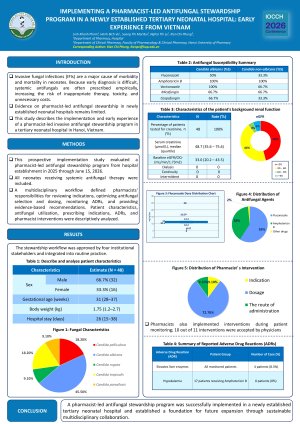
The stewardship workflow was approved by four institutional stakeholders and integrated into routine practice. Forty-eight neonates were included, with a median gestational age of 31 (28–37) weeks, body weight of 1.75 (1.2–2.7) kg, and hospital stay of 26 (15–38) days; 66.7% were male. Empirical therapy accounted for most antifungal use, with fluconazole as the most frequently prescribed agent at a median dose of 12 (10.5–12) mg/kg/day. Elevated liver enzymes were the most common ADR, occurring in four patients (8.3%). Among 17 patients receiving amphotericin B, no hypokalemia occurred. All patients received comprehensive laboratory and ADR monitoring with regular pharmacist follow-up. Pharmacists also implemented interventions during patient monitoring; 10 out of 11 interventions were accepted by physicians, comprising 1 (9.1%) regarding indication, 8 (72.7%) regarding dosage, and 1 (9.1%) regarding the route of administration.
Conclusions:
A pharmacist-led antifungal stewardship program was successfully implemented in a newly established tertiary neonatal hospital and established a foundation for future expansion through sustainable multidisciplinary collaboration.
Keywords
Antifungal stewardship
Clinical pharmacy
Neonates
Invasive fungal infections
Poster
[IOCCH2026]-207009-POSTER.pdf
Use and Implementation of Standardized Neurodevelopmental Assessment Tools by Physiotherapists in Neonatal Care and High-Risk Infant Follow-Up: A Systematic Review
Critical Role of Ultrasound for Differentiating Surgical from Non-Surgical Causes of Greenish Vomiting in Neonates