Event submissions
Published
This submission belongs to the session S2. Neonatology of the event The 1st International Online Conference on Children's Health
Published date
12 Nov, 2026
Academic Editor
 Lin Hungchih
Citation
CECILIA Cc, “Oral vs Rectal Route in Neonatal and Infant Pharmacotherapy: A Global Review of Clinical Efficacy, Acceptability, and Cultural Divides”, in Proceedings of The 1st International Online Conference on Children's Health, 17 November–19 November 2026, MDPI: Basel, Switzerland
Share
Email
Facebook
Twitter
LinkedIn
“Oral vs Rectal Route in Neonatal and Infant Pharmacotherapy: A Global Review of Clinical Efficacy, Acceptability, and Cultural Divides”

CECILIA Cc 1
1. International Class, Faculty of Medicine, Universitas Ciputra Surabaya, Surabaya, 60219, Indonesia
Abstract
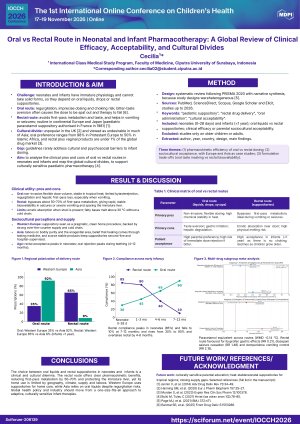
Introduction: Physiological characteristics in neonates and infants complicate medication administration. While the oral route is predominant, dosing inaccuracies from spit-up and bitter taste aversion often cause therapy failure during early childhood transitions. Conversely, rectal suppositories offer distinct pharmacokinetic benefits but face strict socio-cultural barriers and varying market accessibility. This systematic review evaluates the clinical balance, formulation availability, and sociocultural barriers of oral versus rectal pharmacotherapy in Euro-Asian neonates and infants.
Methods: Following PRISMA 2020 guidelines, a literature search was conducted via PubMed, ScienceDirect, Scopus, Google Scholar, and Elicit for studies up to 2026, focusing on formulation effectiveness, commercial supply, and treatment adherence in infants (<1 year old) across Europe and Asia.
Results: The oral route is non-invasive and thermally stable in tropical climates but prone to taste rejection, regurgitation, and drug degradation via first-pass hepatic metabolism. Rectal suppositories bypass 50–70% of first-pass metabolism, ensuring rapid bioavailability during critical emergencies (e.g., neonatal seizures or severe vomiting) while reducing the immature liver's metabolic burden. Geographically, Western Europe widely accepts suppositories as a pragmatic home intervention backed by robust commercial supply. Conversely, commercial availability of stable neonatal suppositories remains limited in developing Asian regions. Asian populations exhibit heavy resistance due to deep-rooted cultural taboos regarding bodily purity and the anogenital area, alongside limited over-the-counter options, confining suppositories to second-line hospital care.
Conclusion: Neonatal and infant drug formulation selection is heavily governed by medical geography, climate, market supply, and culture. Global health policies and the pharmaceutical industry must transition toward adaptive, culturally sensitive infant therapies that address supply disparities and sociocultural taboos rather than relying on a rigid, one-size-fits-all approach.
Keywords
Oral Liquids
Rectal Suppositories
Neonatal Pharmacotherapy
Infant Adherence
Socio-Cultural Taboos.
Formulation Availability
Poster
IOCCH2026_Poster_Sciforum-206139_Cecilia.pdf
Critical Role of Ultrasound for Differentiating Surgical from Non-Surgical Causes of Greenish Vomiting in Neonates
A Clinical Score to Predict CPAP Weaning Success in Late Preterm Neonates: Development and Validation