Event submissions
Published
This submission belongs to the session S3. Neurology, Neurodevelopmental and Metabolic Disorders of the event The 1st International Online Conference on Children's Health
Published date
12 Nov, 2026
Academic Editor
 Bianca Weinstock-Guttman
Citation
Rajiv Balan, Shruti Gupta, Parul Sinha, A Rare Case of Biotinidase Deficiency in an Infant with a Novel Homozygous Indel Variant in the BTD Gene, in Proceedings of The 1st International Online Conference on Children's Health, 17 November–19 November 2026, MDPI: Basel, Switzerland
Share
Email
Facebook
Twitter
LinkedIn
A Rare Case of Biotinidase Deficiency in an Infant with a Novel Homozygous Indel Variant in the BTD Gene

Rajiv Balan 1
Shruti Gupta 1
Parul Sinha 1
1. Department of Pediatrics, Holy Spirit Hospital, Mumbai, 400096, India
Abstract
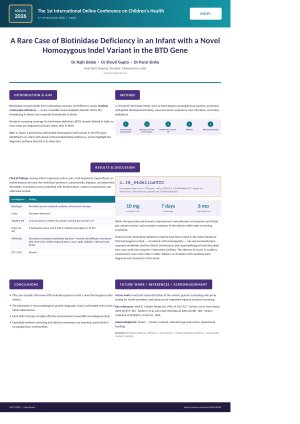
Introduction: Biotinidase deficiency (BTD) is a rare, treatable inborn error of biotin metabolism causing multiple carboxylase deficiency. Early recognition is critical, as untreated disease causes irreversible neurological damage, while biotin supplementation reverses most manifestations. BTD remains underdiagnosed in India due to limited newborn screening coverage.
Methods: We describe a 10-month-old female infant, born of third-degree consanguineous parentage, who presented with global developmental delay, recurrent lower respiratory tract infections, and status epilepticus.
Results: Examination revealed an erythematous perineal and neck rash, conjunctivitis, alopecia, seborrheic dermatitis, hypotonia, and hyporeflexia, with persistent severe metabolic acidosis and ketonuria despite therapy. MRI showed symmetrical delayed myelination with restricted diffusion in characteristic regions. Tandem mass spectrometry showed elevated C3 and C5-OH with abnormal acylcarnitine ratios, and urine GC-MS confirmed elevated 3-hydroxyisovaleric acid and 3-methylcrotonylglycine. Genetic testing identified a homozygous indel variant in exon 2 of the BTD gene (c.38_44delinsTCC), absent from 1000 Genomes, gnomAD, and TopMed databases. The indel in exon 2 (c.38_44delinsTCC) is a frameshift mutation—meaning it shifts the reading frame of the gene, causing all amino acids downstream to be read incorrectly. Oral biotin therapy (10 mg/day) produced rapid clinical improvement, with resolution of seizures, acidosis, and skin lesions; the infant remained well at 6-month follow-up.
Conclusions: This case highlights a previously unreported BTD variant and underscores the diagnostic triad of biochemical, neuroradiological, and genetic findings achievable even in tier-2 laboratory settings. Prompt biotin therapy prevents irreversible neurological sequelae, reinforcing the need for expanded newborn screening and clinical vigilance in consanguineous populations.
Keywords
biotinidase deficiency
Homozygous indel variant
Neurometabolic disorder
Poster
IOCCH2026_Poster_Biotinidase_Deficiency_A0.pdf
Predictors of Early Adverse Outcomes in Neonates with Seizures: A Prospective Observational Study from a Tertiary NICU
Cross-session reproducibility of resting-state EEG metrics in high-risk very-preterm infants: A preliminary reliability study