Event submissions
Published
This submission belongs to the session S3. Neurology, Neurodevelopmental and Metabolic Disorders of the event The 1st International Online Conference on Children's Health
Published date
12 Nov, 2026
Academic Editor
 Bianca Weinstock-Guttman
Citation
Guru Jothiramalingam, Kabilesh Karthikeyan, Nandhini Ramachandran, Koushikee Raguraman, Saramma Mini Jacob, Role of Postpartum Depression in the Risk of Delayed Child Developmental Milestones: A Cross-Sectional Study Within the First Year of Life, in Proceedings of The 1st International Online Conference on Children's Health, 17 November–19 November 2026, MDPI: Basel, Switzerland
Share
Email
Facebook
Twitter
LinkedIn
Role of Postpartum Depression in the Risk of Delayed Child Developmental Milestones: A Cross-Sectional Study Within the First Year of Life

Guru Jothiramalingam 1

Kabilesh Karthikeyan 1
Nandhini Ramachandran 1
Koushikee Raguraman 2
Saramma Mini Jacob 2
1. Sree Balaji Medical College and Hospital, Bharath Institute of Higher Education and Research (BIHER), Chennai, 600044, India
2. Research and Development Wing, Sree Balaji Medical College and Hospital, Bharath Institute of Higher Education and Research (BIHER), Chennai, 600044, India
Abstract
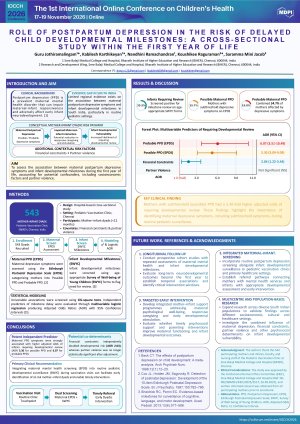
Introduction: Postpartum depression (PPD) is a common maternal mental health disorder that may adversely affect infant neurodevelopment. However, evidence from South India remains limited. This study examined the association between maternal postpartum depressive symptoms and developmental milestones during the first year of life.
Methods: A hospital-based cross-sectional study was conducted among 543 mother–infant dyads attending a pediatric vaccination clinic in Chennai, India. Maternal depressive symptoms were assessed using the Edinburgh Postnatal Depression Scale (EPDS), while infant developmental status was screened using age-appropriate Survey of Well-being of Young Children (SWYC) milestone forms. Associations were analyzed using chi-square tests and multivariable logistic regression.
Results: Overall, 35.5% of infants required developmental review. Possible and probable postpartum depression were identified in 15.7% and 19.0% of mothers, respectively. Maternal depressive symptoms, financial constraints, and partner violence were significantly associated with developmental risk (all p < 0.001). After adjustment, infants of mothers with possible depression (AOR 5.30, 95% CI 3.09 to 9.09) and probable depression (AOR 6.07, 95% CI 3.51 to 10.49) had significantly higher odds of requiring developmental review. Financial constraints also remained independently associated with developmental risk (AOR 2.04, 95% CI 1.22 to 3.44), whereas partner violence was no longer statistically significant.
Conclusions: Maternal postpartum depressive symptoms were strongly associated with developmental vulnerability during the first year of life. Integrating maternal mental health screening into routine pediatric developmental surveillance could facilitate early identification of at-risk mother–infant dyads and enable timely intervention.
Keywords
Postpartum depression
Infant development
Neurodevelopment
Edinburgh Postnatal Depression Scale
Survey of Well-being of Young Children
Maternal mental health
Developmental screening
Poster
IOCCH_2026_PPD_GURU.pdf
Achievement of Glycaemic Targetsin Ethiopian Children and Adolescents with Type 1 Diabetes: A Multi-Indicator Assessment
Systematic review: Educational ecosystem for autistic students in mainstream schools