Event submissions
Published
This submission belongs to the session S4. Orthopedics and Sports Medicine of the event The 1st International Online Conference on Children's Health
Published date
12 Nov, 2026
Academic Editor
 Erich Rutz
Citation
Ivana Sović, Tanja Grubić Kezele, Verner Marijančić, Mirela Vučković, Mia Hrlec, Gordana Starčević-Klasan, Antonio Kokot, Differences in thoracic kyphosis, lumbar lordosis, and spinal mobility in athletic and non-athletic prepubertal children, in Proceedings of The 1st International Online Conference on Children's Health, 17 November–19 November 2026, MDPI: Basel, Switzerland
Share
Email
Facebook
Twitter
LinkedIn
Differences in thoracic kyphosis, lumbar lordosis, and spinal mobility in athletic and non-athletic prepubertal children

Ivana Sović 1

Tanja Grubić Kezele 1,2

Verner Marijančić 3
Mirela Vučković 3
Mia Hrlec 4
Gordana Starčević-Klasan 1

Antonio Kokot 5
1. Department of Basic Medical Sciences, Faculty of Health Studies, University of Rijeka, Rijeka, 51000, Croatia
2. Department of Clinical Microbiology, Clinical Hospital Center Rijeka, Rijeka, 51000, Croatia
3. Department of Physiotherapy, Faculty of Health Studies, University of Rijeka, Rijeka, 51000, Croatia
4. Department of Anesthesiology and Intensive Care, Clinical Hospital Center Rijeka, Rijeka, 51000, Croatia
5. Department of Anatomy and Neuroscience, Faculty of Medicine, Josip Juraj Strossmayer University of Osijek, Osijek, 31000, Croatia
Abstract
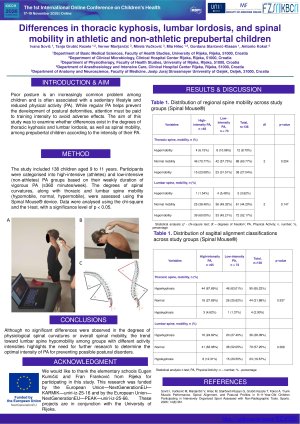
Introduction: Poor posture is an increasingly common problem among prepubescent children and is often associated with a sedentary lifestyle and reduced physical activity (PA). While regular physical activity helps prevent the development of postural deformities, attention must be paid to training intensity to avoid adverse effects. The aim of this study was to examine whether differences exist in the degrees of thoracic kyphosis and lumbar lordosis, as well as spinal mobility, among prepubertal children according to the intensity of their PA.
Methods: The study included 138 children aged 9 to 11 years. Participants were categorised into high-intensity (athletes) and low-intensity (non-athletes) PA groups based on their weekly duration of vigorous PA (≥360 minutes/week). The degrees of spinal curvatures, along with thoracic and lumbar spine mobility (hypomobile, normal, hypermobile), were assessed using the Spinal Mouse® device. Data were analysed using the chi-square test and the Mann–Whitney U test, with a significance level of p < 0.05.
Results: Of the 73 (52.9%) non-athletes, 23 (31.5%) exhibited thoracic spine hypomobility (χ² = 2.745; df = 2; p = 0.254). Among the 65 (47.1%) athletes, 39 (60.0%) exhibited lumbar spine hypomobility (χ² = 3.833; df = 2; p = 0.147). No significant differences were found in the degrees of thoracic kyphosis and lumbar lordosis in relation to the intensity of physical activity (pK = 0.937; pL = 0.368).
Conclusions: Although no significant differences were observed in the degrees of physiological spinal curvatures, the hypomobility of the thoracic and lumbar spine across groups with different activity intensities indicates the need for further research into the optimal intensity of PA for the prevention of postural disorders.
Keywords
children
lumbar lordosis
physical activity
spine mobility
thoracic kyphosis
Poster
Poster_Sovic_et_al.pdf
Epidemiology and clinical outcomes of pediatric pelvic fractures: A retrospective study from two Level-1 trauma centers
Physical Performance Responses to Structured Movement Variability in a Basketball-Adjusted FIFA 11+ Warm-Up