Event submissions
Published
This submission belongs to the session S4. Orthopedics and Sports Medicine of the event The 1st International Online Conference on Children's Health
Published date
12 Nov, 2026
Academic Editor
 Erich Rutz
Citation
Alejandro Gutiérrez Capote, Ricardo Birrento Aguiar, José López-Morales, Lidia Martínez Jiménez, Francisco García-Angulo, David Cárdenas, Enrique Ortega, Nuno Leite, Jorge Arede, Maturation-Adjusted Performance, Shooting, and Injury Outcomes Following Differential Plyometric Training in Youth Basketball, in Proceedings of The 1st International Online Conference on Children's Health, 17 November–19 November 2026, MDPI: Basel, Switzerland
Share
Email
Facebook
Twitter
LinkedIn
Maturation-Adjusted Performance, Shooting, and Injury Outcomes Following Differential Plyometric Training in Youth Basketball

Alejandro Gutiérrez Capote 1
Ricardo Birrento Aguiar 2
José López-Morales 1
Lidia Martínez Jiménez 2

Francisco García-Angulo 2
David Cárdenas 1
Enrique Ortega 2

Nuno Leite 3,4

Jorge Arede 3,4,5
1. Department of Physical Education and Sport, Faculty of Sports Science, University of Granada, Granada, Spain
2. Department of Physical Activity and Sport, Faculty of Sport Science, University of Murcia, Murcia, Spain
3. Department of Sports Sciences, Exercise and Health, University of Trás-os-Montes and Alto Douro, Vila Real, Portugal
4. Research Centre in Sports Sciences, Health Sciences and Human Development (CIDESD), Vila Real, Portugal
5. School of Education, Polytechnic Institute of Viseu, Viseu, Portugal
Abstract
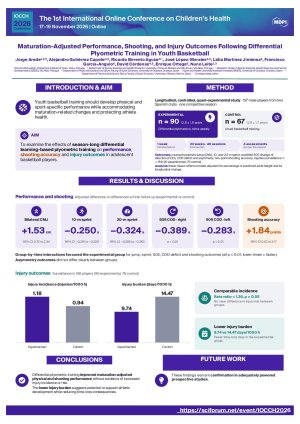
Introduction: Youth basketball training should develop physical and sport-specific performance while accommodating maturation-related changes and protecting athlete health. This study examined the effects of season-long differential learning-based plyometric training on performance, shooting accuracy, and injury outcomes in adolescent basketball players.
Methods: A longitudinal, controlled, quasi-experimental study included 157 male players from two Spanish clubs (experimental: n = 90, 12.8 ± 1.8 years; control: n = 67, 12.8 ± 1.7 years); injury surveillance included 166 players (90 experimental, 76 control). After one familiarisation week, the experimental group completed differential plyometrics twice weekly for 23 intervention weeks (46 sessions) distributed across one competitive season, whereas the control group continued usual basketball training. Four assessments evaluated countermovement jump, 10- and 20-m sprint, modified 505 change of direction, change-of-direction deficit and asymmetry, two-point shooting accuracy, and injuries. Linear mixed-effects models adjusted for percentage of predicted adult height and its longitudinal change.
Results: Group-by-time interactions favoured the experimental group for jump, sprint, 505, change-of-direction deficit, and shooting outcomes. At final follow-up, adjusted difference-in-differences were 1.53 cm for bilateral jump (95% CI 0.72 to 2.34), -0.250 s for 10-m sprint (-0.291 to -0.209), -0.324 s for 20-m sprint (-0.385 to -0.263), -0.389 and -0.283 s for right- and left-side 505, respectively, and 1.84 points for shooting accuracy (0.52 to 3.17; all p < 0.01). Asymmetry outcomes did not differ clearly between groups. Injury incidence was comparable (1.18 versus 0.94 injuries/1000 h; rate ratio = 1.26, p > 0.05), with no clear difference in injury risk, while injury burden was lower in the experimental group (9.74 versus 14.47 days/1000 h).
Conclusions: Differential plyometric training improved maturation-adjusted physical and shooting performance without evidence of increased injury incidence or risk. The lower injury burden suggests potential to support athletic development while reducing time-loss consequences, warranting confirmation in adequately powered prospective studies.
Keywords
movement variability
neuromuscular adaptation
paediatric exercise
lower-limb power
motor competence
Poster
Poster_IOCCH2026_differential_plyometrics.pdf
Physical Performance Responses to Structured Movement Variability in a Basketball-Adjusted FIFA 11+ Warm-Up
Exploring Motivational Strategies for Scoliosis Orthosis Wear Using Health Design Thinking: A Co-design Study in Norway