Event submissions
Published
This submission belongs to the session S4. Orthopedics and Sports Medicine of the event The 1st International Online Conference on Children's Health
Published date
12 Nov, 2026
Academic Editor
 Erich Rutz
Citation
NADA EL FADIL, Mustapha Mouilly, Redouane Elfezazi, Elmouhtadi Aghoutane, Determinants of Physical Activity in Children with Surgically Treated Developmental Dysplasia of the Hip (DDH): A Case–Control Study, in Proceedings of The 1st International Online Conference on Children's Health, 17 November–19 November 2026, MDPI: Basel, Switzerland
Share
Email
Facebook
Twitter
LinkedIn
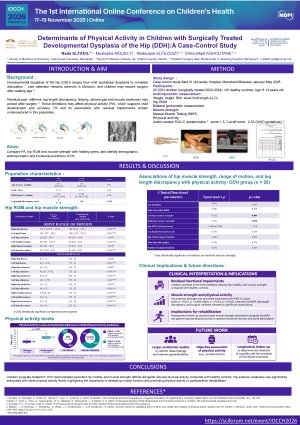
Determinants of Physical Activity in Children with Surgically Treated Developmental Dysplasia of the Hip (DDH): A Case–Control Study

NADA EL FADIL 1
Mustapha Mouilly 2
Redouane Elfezazi 1,3
Elmouhtadi Aghoutane 1,3
1. Faculty of Medicine and Pharmacy, Cadi Ayyad University, Marrakesh, Morocco
2. Sports profession Institute, Ibn Tofail University, Kenitra, Morocco
3. Pediatric surgery department, University Hospital Mohammed VI, Marrakesh, Morocco
Abstract
Physical activity (PA) is widely recognized for its physical, psychological, and social benefits in healthy children and in those with musculoskeletal conditions such as developmental dysplasia of the hip (DDH). In pediatric orthopedics, PA is considered to play an important role in recovery and long-term joint health. Although functional limitations following DDH surgery have been documented, factors associated with PA levels in this population remain poorly understood.
AIM: This study aimed to compare PA levels between children surgically treated for DDH and their healthy peers and to explore demographic, anthropometric, surgical, and functional factors associated with PA among children with DDH.
METHODS: Between January and May 2025, twenty children with DDH (8–14 years) and 20 sex- and age-matched healthy controls underwent standardized physical examination at Mohammed VI University Hospital, Marrakech. Hip ROM, isometric muscle strength, BMI, and lower limb length discrepancy were assessed. Surgical characteristics were obtained from medical records. PA was assessed using the Arabic PAQ-C. Factors associated with PA were explored using domain-specific regression analyses.
RESULTS: The median age was 9.5 years in both groups (17 girls/3 boys each), with comparable weight, height, and BMI (all p>0.05). The median follow-up was 38.5 months [IQR 25.25–61.75] and the median time since the most recent surgery was 27 months [IQR 16.25–43]. Children with DDH demonstrated significantly lower PA levels than controls (median 1.84 [1.35–2.07] vs 2.73 [2.25–3.11]). Moreover, 85% of the DDH group did not meet World Health Organization recommendations for PA. In separate domain-specific models, sex, BMI, lower limb length discrepancy, left hip flexion ROM, and left hip extensor strength were associated with PA levels, whereas surgical characteristics, including age at first surgery, were not.
CONCLUSION: Children surgically treated for DDH exhibit reduced PA levels compared with their healthy peers. Demographic, anthropometric, and functional characteristics may be associated with PA participation, highlighting potentially modifiable factors for rehabilitation. Larger prospective studies are needed to confirm these associations and determine whether targeted rehabilitation can improve PA participation.
Keywords
case-control study
Children
physical activity PA
Developmental Dysplasia of the Hip (DDH)
PAQ-C.
Poster
Nada ELFADIL_DDH Poster.pdf
Rehabilitation Needs and Assistive Technology Provision in Children with Down Syndrome: A Real-World Cross-Sectional Study
Physical Activity, Body Composition, and Ultrasonographic Characteristics of the Anterior Abdominal Wall in School-Aged Children