Event submissions
Published
This submission belongs to the session S5. Dentistry and Oral Medicine of the event The 1st International Online Conference on Children's Health
Published date
12 Nov, 2026
Academic Editor
 Simona Tecco
Citation
Mrunali Abhishek Katkar, Nandan Rao, Chetan Hotkar, Amit Padmai, Shilpa Shetty, Minimally Invasive Management of Early Childhood Caries: Strategies in Conservative Dentistry for Long-Term Oral Health, in Proceedings of The 1st International Online Conference on Children's Health, 17 November–19 November 2026, MDPI: Basel, Switzerland
Share
Email
Facebook
Twitter
LinkedIn
Minimally Invasive Management of Early Childhood Caries: Strategies in Conservative Dentistry for Long-Term Oral Health

Mrunali Abhishek Katkar 1
Nandan Rao 1
Chetan Hotkar 1
Amit Padmai 1
Shilpa Shetty 1
1. Department of Conservative Dentistry and Endodontics, Tatyasaheb Kore Dental College and Research Center, Kolhapur, Maharashtra, India
Abstract
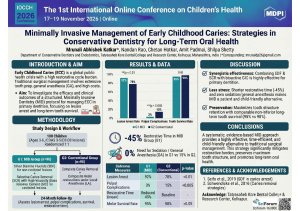
Early Childhood Caries (ECC) remains a global public health crisis, severely impacting the quality of life and general health of millions of children. Traditional surgical management often involves extensive tooth preparation, general anesthesia, and high treatment costs, leading to a significant restorative cycle burden. This research investigates the efficacy and clinical outcomes of a structured, Minimally Invasive Dentistry (MID) protocol designed for the comprehensive management of ECC in the primary dentition, focusing on sustained lesion arrest and long-term tooth survival.
The study employed a prospective, randomized clinical trial (RCT) design involving 180 children (ages 3–6) diagnosed with D2–D3 (ICDAS 3–5) lesions. Participants were randomized into two groups: the MID Group (G1), receiving a combination of Silver Diamine Fluoride (SDF) arrestment for non-cavitated lesions and Selective Caries Removal (SCR) followed by restoration with a high-viscosity Glass Ionomer Cement (GIC) for cavitated lesions; and the Conventional Group (G2), receiving complete caries removal and composite resin restorations under local anesthesia.
The 24-month follow-up revealed that the MID protocol (G1) demonstrated a significantly higher lesion arrest rate (92% vs. 78%; p < 0.01) and a lower incidence of pulpal complications (3% vs. 15%; p < 0.005) compared to the conventional approach. Crucially, the mean restorative time was reduced by 45% in G1, and the need for sedation or general anesthesia was eliminated. The study’s most significant outcome is the finding that SCR followed by GIC restoration, combined with biannual SDF application to adjacent at-risk surfaces, resulted in a 95% survival rate for the restored primary molars, statistically non-inferior to the conventional group’s 98% survival rate.
This research concludes that a systematic, evidence-based MID approach, heavily reliant on the synergistic application of SDF and selective-carious-tissue removal with bioactive materials, provides a highly effective, time-efficient, and child-friendly alternative to traditional surgical management. This strategy significantly mitigates the restorative burden, preserves maximum tooth structure, and promotes long-term oral health.
Keywords
Silver Diamine Fluoride (SDF)
Selective Caries Removal (SCR)
Glass Ionomer Cement (GIC)
Lesion Arrest
Primary Dentition
Tooth Preservation
Poster
Poster_sci_163000.pdf
Influence of Pre-Heated High-Viscosity Glass Ionomer Cement on Marginal Adaptation and Post-Operative Sensitivity in Pediatric Restorations: A Split-Mouth Randomized Clinical Trial
Decoding the Pediatric Oral–Gut–Brain Axis: Microbiome Dynamics, Digital Diagnostics, and Neurodevelopmental Correlates in Early Childhood