Event submissions
Published
This submission belongs to the session S2. Neonatology of the event The 1st International Online Conference on Children's Health
Published date
12 Nov, 2026
Academic Editor
 Lin Hungchih
Contribution&Funding
Data curation,
[Li Fang]
Writing - original draft,
[Yue Shen]
Funding acquisition,
[Chen Gao Yan]
Funding: --
Citation
Yue Shen, Li Fang, Chen Gao Yan, Cradle hold alleviates pain, reduces fear behavior, and stabilizes oxygenation in preterm infants
during ROP screening: a randomized controlled trial, in Proceedings of The 1st International Online Conference on Children's Health, 17 November–19 November 2026, MDPI: Basel, Switzerland
Share
Email
Facebook
Twitter
LinkedIn
Cradle hold alleviates pain, reduces fear behavior, and stabilizes oxygenation in preterm infants
during ROP screening: a randomized controlled trial

Yue Shen 1
Li Fang 1
Chen Gao Yan 1
1. Department of Neonatology, Xiangyang Central Hospital, Xiangyang City, 441021, China
Abstract
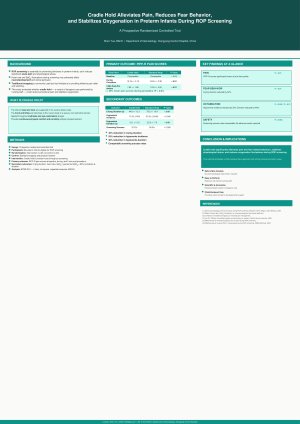
Objective: To evaluate cradle hold—a nurse-performed kangaroo care variant—on procedural pain, behavioral stress, and physiological stability during retinopathy of prematurity (ROP) screening in preterm infants. ROP screening is essential for preventing blindness yet causes significant acute pain and physiological stress in vulnerable preterm infants.
Methods: Prospective randomized controlled trial. Eighty preterm infants were randomized to intervention (cradle hold by trained nurse throughout mydriasis and eye examination, n=40) or control (standard wrapping and physical restraint, n=40). In cradle hold, the infant's head and neck rest in the nurse's elbow crook with trunk and limbs held close to the body in a secure, non-restrictive manner. Primary outcome: PIPP-R pain scores at baseline, during, and 5 min post-procedure. Secondary: crying duration, heart rate, SpO₂, hypoxemia (SpO₂<85%) incidence and duration.
Results: No baseline differences. Intervention had lower PIPP-R during procedure (10.18±2.10 vs 14.50±2.38, P<0.01) and at 5 min (7.80±1.88 vs 11.20±2.05, P<0.01); shorter crying (44.8±12.1s vs 78.2±15.4s, P<0.01); lower hypoxemia incidence (17.5% vs 37.5%, P=0.045) and duration (12.1±5.0s vs 23.2±7.6s, P<0.01); comparable screening success (97.5% vs 95.0%, P=0.556).
Conclusion: Cradle hold alleviates pain and fear behaviors, stabilizes physiology, and reduces oxygen fluctuations during ROP screening—safe, non-invasive, easy to perform, and child-centered.
Keywords
Cradle hold; Kangaroo care; Preterm infant; Retinopathy of prematurity (ROP); Procedural pain; PIPP-R; Hypoxemia; Randomized controlled trial; Neonatal nursing; Child-centered care
Poster
壁报.pdf
Knowledge, Attitudes, and Practices of Nurses Regarding Oral Disorders in Premature Newborns: A cross-sectional descriptive study in neonatal and pediatric intensive care units
Construction and Assessment of Machine Learning Models of Brain Injury Risk Prediction in Preterm Twin Neonates