Event submissions
Published
This submission belongs to the session S1. Drone Design and Development of the event Drones 2026: Mapping the Knowledge
Published date
12 Nov, 2026
Citation
Iris Graessler, Julius Goldstein, Future-Resilient UAV Payload Modules: Deriving Design Requirements based on a Structured Market Analysis, in Proceedings of Drones 2026: Mapping the Knowledge, Barcelona, 11 November–13 November 2026, MDPI: Basel, Switzerland
Share
Email
Facebook
Twitter
LinkedIn
Future-Resilient UAV Payload Modules: Deriving Design Requirements based on a Structured Market Analysis

Iris Graessler 1
Julius Goldstein 1
1. Chair of Product Creation, Department of Mechanical Engineering, Paderborn University, 33098 Paderborn, Germany
Abstract
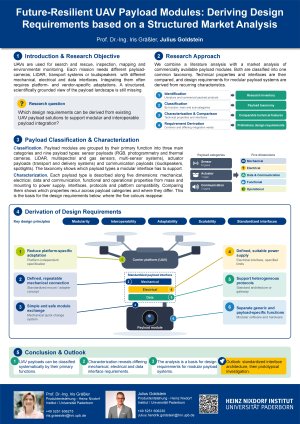
The growing availability of mature Unmanned Aerial Systems (UASs) places payload modules at the center of mission-specific functionality. As UASs are increasingly deployed across diverse application domains, modular payloads enable rapid adaptation to changing mission requirements while improving operational flexibility and efficiency. While existing research predominantly focuses on UAS platforms and flight planning, payload is often proposed with very specific and, thus, limited use cases. There is a lack of a structured and scientifically grounded understanding of the overall payload landscape and its mapping to modular system architecture design. In particular, there is no comprehensive framework that systematically combines insights from the scientific literature with commercially available payload solutions and derives implications for the design of future payload systems.
This paper addresses this research gap through a structured research approach that combines systematic literature analysis with market analysis. First, the state of the art on UAS payloads is synthesized from the scientific literature to identify existing payload categories, functional capabilities, technological characteristics, and architectural concepts. In parallel, commercially available payload modules are analyzed and classified according to functional, technological, and application-specific dimensions. The findings from both analyses are then consolidated into a unified taxonomy of UAV payload modules, which forms the basis for identifying common design characteristics and deriving requirements for future payload systems.
Building upon this consolidated knowledge base, the paper derives design requirements for future-resilient payload modules by synthesizing recurring characteristics identified in both the scientific literature and existing industrial solutions. Particular emphasis is placed on modularity, interoperability, adaptability, scalability, and standardized interfaces to support flexible deployment across evolving mission requirements. Based on these requirements, architectural design principles for modular payload systems, standardized payload interfaces and compatibility between payload modules and carrier platforms are derived, enabling payload architectures that remain applicable across changing operational environments and disaster response scenarios.
Keywords
Payload Modules
Modular Architectures
Market Analysis
Design Requirements
Poster
Poster_Payload_Drones2026_v100.pdf
Multi-Robot Systems for Precision Agriculture
Using drones to derive fuel load estimates in semi-arid rangelands