Event submissions
Published
This submission belongs to the session S4. Artificial Intelligence Applications for Drones of the event Drones 2026: Mapping the Knowledge
Published date
12 Nov, 2026
Citation
Gabriel de Sousa Meira, Edilson de Souza Bias, Raul Queiroz Feitosa, João Victor Ferreira Guedes, Deep Learning-Based Detection of Paint Peeling: An Evaluation of CNN Architectures for Automated Building Inspections, in Proceedings of Drones 2026: Mapping the Knowledge, Barcelona, 11 November–13 November 2026, MDPI: Basel, Switzerland
Share
Email
Facebook
Twitter
LinkedIn
Deep Learning-Based Detection of Paint Peeling: An Evaluation of CNN Architectures for Automated Building Inspections

Gabriel de Sousa Meira 1
Edilson de Souza Bias 1
Raul Queiroz Feitosa 2
João Victor Ferreira Guedes 3
1. Institute of Geosciences - University of Brasilia
2. Pontifical Catholic University of Rio de Janeiro, Dept Electrical Engineering
3. Corumbá Concessões S.A.
Abstract
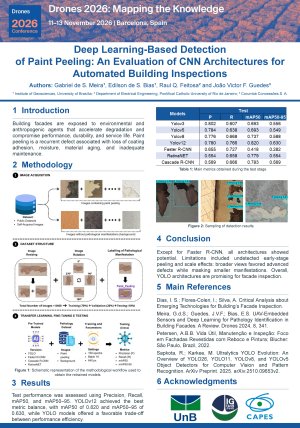
Building facades are exposed to environmental and anthropogenic agents that accelerate degradation and compromise performance, durability, and service life. Paint peeling is a recurrent defect associated with loss of coating adhesion, moisture, material aging, and inadequate maintenance. This study evaluated convolutional neural networks for automatic paint-peeling detection on building facades. The dataset comprised 8,400 manually annotated image patches (448 × 448 pixels), predominantly from author-acquired images. Most source images were captured manually with a handheld RGB camera, while a smaller complementary portion was acquired using a DJI Air 2S UAV equipped with an RGB camera at variable distances of up to 5 m from the facades. Because manual acquisition predominated and capture distances varied, the dataset lacks a uniform flight-height range or spatial resolution. As standardized augmentation, each image and its annotations were rotated about the image center by 0°, 90°, 180°, and 270°. The dataset was divided into training, validation, and test subsets at a 70:20:10 ratio. Images were resized to 640 × 640 pixels during training and inference. Pre-trained YOLOv3, YOLOv5, YOLOv8, YOLOv12, Faster R-CNN, RetinaNet, and Cascade R-CNN models were retrained through transfer learning and fine-tuning. No systematic hyperparameter optimization was performed; predefined settings and implementation-default hyperparameters were used. A maximum of 150 epochs was established. YOLO models used native early stopping, whereas the remaining models were manually stopped based on learning-curve stagnation or overfitting. Test performance was assessed using Precision, Recall, mAP50, and mAP50–95. Except for Faster R-CNN, all architectures showed potential. YOLOv12 achieved the best metric balance, with an mAP50 of 0.820 and mAP50–95 of 0.630, while YOLO models offered a favorable trade-off between performance and training efficiency. Limitations included undetected early-stage peeling and scale effects: broader views favored advanced defects while masking smaller manifestations. Overall, YOLO architectures are promising for facade inspection.
Keywords
Automated inspection
Object detection
Transfer learning
Building Pathology
Poster
Poster Gabriel Meira.pdf
Application of RPA and AI in the Identification of Pests in Cotton Plantations in the Brazilian Cerrado
Drone-Based Maritime Geospatial Intelligence: Automated Vessel Detection, Positioning and Characterization