Event submissions
Published
This submission belongs to the session S5. Drones in Rangelands, Agriculture, and Forestry of the event Drones 2026: Mapping the Knowledge
Published date
12 Nov, 2026
Citation
Seonghyeok Bang, Changhoon Bang, Water Spray Efficiency of UAV-Scale Aerial Firefighting under Crosswind Conditions: An FDS-Based Dimensionless Analysis for Operational Design, in Proceedings of Drones 2026: Mapping the Knowledge, Barcelona, 11 November–13 November 2026, MDPI: Basel, Switzerland
Share
Email
Facebook
Twitter
LinkedIn
Water Spray Efficiency of UAV-Scale Aerial Firefighting under Crosswind Conditions: An FDS-Based Dimensionless Analysis for Operational Design

Seonghyeok Bang 1
Changhoon Bang 2
1. Department of Fire and safety engineering, Kyungnam University Graduate school
2. Department of Fire and safety engineering, Kyungnam University
Abstract
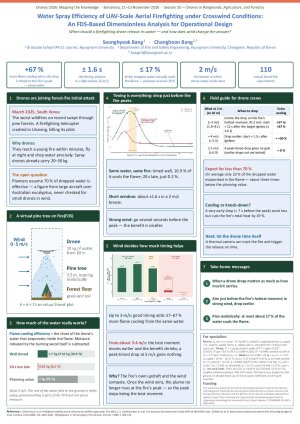
Wildfires increasingly threaten forests worldwide, and uncrewed aerial vehicles (UAVs) are emerging as valuable tools for early-stage suppression—especially in forestry and agricultural landscapes where rapid, targeted water delivery can stop a fire before it spreads. Yet how much water a firefighting drone truly needs remains poorly understood, because current planning relies on a fixed efficiency value (70%) borrowed from large-scale eucalyptus forest operations that was never validated for small drones operating in wind. This study uses high-resolution fire simulation to quantify how effectively water sprayed from a UAV reaches and cools a wildfire flame across a realistic range of wind conditions. Forty scenarios were examined, varying wind speed, spray release speed, and the timing of the water drop relative to the fire's growth. Wind emerged as the dominant factor governing effectiveness, with efficiency ranging widely from about 1.5% to 40%. A notable "sweet spot" was found at moderate wind (around 2 m/s), where rising heat and crosswind balance to keep water in contact with the flame longest; releasing water precisely as the fire peaks improved effectiveness by up to 50%. Overall, the conventional 70% assumption overestimates real drone performance by roughly three-and-a-half times. The study delivers practical, wind-adjusted guidance to help forestry and emergency-response teams plan drone water loads, laying a foundation for smarter autonomous aerial firefighting in vulnerable pine-forest regions such as Korea.
Keywords
firefighting drones; aerial wildfire suppression; forestry drone operations; water spray efficiency; wind effects; fire simulation; precision water delivery; Korean pine forest
Poster
Drones2026_Sciforum-191397_Water Spray Efficiency of UAV-Scale Aerial Firefighting under Crosswind Conditions.pdf
Predictive performance of a machine learning model for plot-level dry matter yield estimation using drone derived multispectral indices.
Bitemporal Integration of Spectral Indices Obtained from UAS–Sentinel-2 Images for the Estimation and Spatial Analysis of Maize Yield