Event submissions
Published
This submission belongs to the session S3. Guidance, Navigation, and Control of the event Drones 2026: Mapping the Knowledge
Published date
12 Nov, 2026
Citation
Miguel-Ángel Fas-Millán, Norberto Vera-Vélez, Enno Nagel, Definition of U-plan 4D volumes and their impact on flight authorisation and airspace capacity, in Proceedings of Drones 2026: Mapping the Knowledge, Barcelona, 11 November–13 November 2026, MDPI: Basel, Switzerland
Share
Email
Facebook
Twitter
LinkedIn
Definition of U-plan 4D volumes and their impact on flight authorisation and airspace capacity

Miguel-Ángel Fas-Millán 1
Norberto Vera-Vélez 2
Enno Nagel 3
1. DLR
2. Eurocontrol
3. German Aerospace Center (DLR)
Abstract
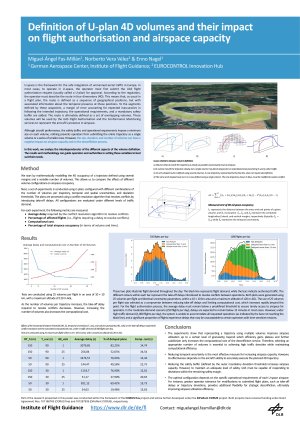
Unmanned Aerial System (UAS) traffic management (UTM) environments, including the European U-space, are designed to enable the safe integration of large numbers of UAS operations into the airspace. One of the safety measures consists of the strategic deconfliction of the trajectories, defined as a series of 4D volumes within which the aircraft must remain. A flight authorisation service must prevent these volumes from overlapping (i.e., in time and space) when belonging to different flights. In case of overlap, the flight requests can be rejected or modified to resolve the conflicts and make them feasible. Besides the level of demand, a key factor that contributes to the number of rejected or modified flight requests is how the 4D volumes are defined, including their applicable deviation thresholds. Such definition will impact the airspace capacity and flight approval rate, thereby conditioning access to the airspace. In this work, we identify the advantages and disadvantages of different 4D volume definition decisions. Examples of these decisions illustrate how they affect access to the airspace given different levels of demand. This can help to identify the trade-offs that better fit the specific needs of a given airspace and guide Member States to establish flight authorisation constraints to ensure fair and efficient access to their U-space airspace.
Keywords
unmanned aerial vehicles
U-space
4D volume
airspace capacity
Poster
poster_FasMillan.pdf
Radiometric Correction of UAV Multispectral Imagery Under Variable Illumination using a Single Calibrated Reflectance Panel
Uncertainty-Aware FLARM-Based Conflict Detection for Low-Altitude UAS Operations