Event submissions
Published
This submission belongs to the session S3. Guidance, Navigation, and Control of the event Drones 2026: Mapping the Knowledge
Published date
12 Nov, 2026
Citation
Somnath Lingaraj Panigrahi, Martin Lindner, Hartmut Fricke, Uncertainty-Aware FLARM-Based Conflict Detection for Low-Altitude UAS Operations, in Proceedings of Drones 2026: Mapping the Knowledge, Barcelona, 11 November–13 November 2026, MDPI: Basel, Switzerland
Share
Email
Facebook
Twitter
LinkedIn
Uncertainty-Aware FLARM-Based Conflict Detection for Low-Altitude UAS Operations

Somnath Lingaraj Panigrahi 1
Martin Lindner 1

Hartmut Fricke 1
1. Chair of Air Transport Technology and Logistics, Technische Universität Dresden, Dresden, Germany
Abstract
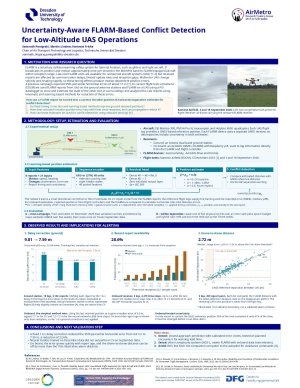
Safe operation of cooperative unmanned aircraft systems in U-space environments in particular, but also in any other airspace requires surveillance that is accurate, real-time, and reliable to support conflict alerting. FLARM, a low-cost position broadcast technique well-established for gliders may provide electronic conspicuity also for cooperative UAS, though reports can contain communication delay, update-rate limitations, and temporary data gaps. Building on the recent flight-test measurements, where FLARM achieved a 95th-percentile horizontal error of 16.80 m and showed an approximately 1.91 s time offset, the current work investigates an uncertainty-aware FLARM-based conflict detection model for UAS operations with varying flight characteristics, generally having lower inertia than gliders.
The method first characterises surveillance error by aligning FLARM reports received at a ground-based traffic monitoring unit with reference trajectories, estimating sensor-specific time offsets, and modelling residual along-track and cross-track errors as functions of motion state, update time and potential offset, and manoeuvre dynamics from real flight tests. Physics-based baselines, including fixed time-offset compensation, constant-velocity, or constant-acceleration propagation, and Kalman filtering, are compared with lightweight learning-based residual models using Long Short-Term Memory (LSTM) and Gated Recurrent Unit (GRU) networks.
The corrected trajectory estimate and its uncertainty envelope are then intended to support a probabilistic conflict detection module based on predicted closest point of approach over a 30-second tactical look-ahead horizon. Instead of using fixed geometric thresholds alone, the alert boundary is inflated according to estimated positional uncertainty and track age, enabling more conservative warnings when reports are stale or unreliable. The expected outcome is an FLARM error-aware ground-station alerting framework, with future extension toward onboard receiver-based advisory generation and autopilot-assisted avoidance recommendations.
Keywords
FLARM
UAS Traffic Management (UTM)
cooperative surveillance
uncertainty-aware conflict detection
trajectory prediction
surveillance uncertainty
Poster
Somnath_drones_poster.sp02_081126.pdf
Definition of U-plan 4D volumes and their impact on flight authorisation and airspace capacity
Spatiotemporal Multi-Modal Sensor Synchronization for High-Speed Aerial Platforms