Event submissions
Published
This submission belongs to the session S3. Guidance, Navigation, and Control of the event Drones 2026: Mapping the Knowledge
Published date
12 Nov, 2026
Contribution&Funding
Conceptualization,
[Toma Sikora] ; [Vladan Papić]
Methodology,
[Toma Sikora]
Software,
[Toma Sikora]
Validation,
[Toma Sikora]
Visualization,
[Toma Sikora]
Supervision,
[Vladan Papić]
Project administration,
[Vladan Papić]
Funding: --
Citation
Toma Sikora, Vladan Papić, MD-MCTS: Multimodal Determinized Monte Carlo Tree Search for UAV Multi-Target Rendezvous, in Proceedings of Drones 2026: Mapping the Knowledge, Barcelona, 11 November–13 November 2026, MDPI: Basel, Switzerland
Share
Email
Facebook
Twitter
LinkedIn
MD-MCTS: Multimodal Determinized Monte Carlo Tree Search for UAV Multi-Target Rendezvous

Toma Sikora 1

Vladan Papić 1
1. Faculty of Electrical Engineering, Mechanical Engineering and Naval Architecture, University of Split, Split, 21000, Croatia
Abstract
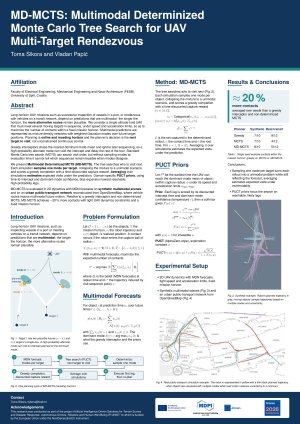
Long-horizon UAV missions such as successive inspection of vessels in a port, or rendezvous with vehicles on a transit network, depend on predictions that are multimodal: the longer the horizon, the more alternative routes remain plausible. We consider a single altitude-hold UAV that must meet several moving targets in sequence, under speed and acceleration limits, so as to maximize the number of contacts within a fixed mission horizon. Multimodal predictions are represented as mixture density networks with weighted Gaussian modes over future target positions. Planning is online and receding horizon and the planner’s decision is the next target to visit, not unconstrained continuous control.
Greedy interceptors chase the nearest dominant-mode mean and ignore later sequencing, so a high-probability alternate mode can void the intercept and delay the rest of the tour. Standard Monte Carlo tree search (MCTS) can search visit order, but without sampling modes at evaluation time it cannot tell which sequences remain feasible when modes disagree.
We present Multimodal Determinized MCTS (MD-MCTS). The tree searches who to visit next. Each simulation samples one mode per target, collapsing the mixture to a unimodal scenario, and scores a greedy completion with a time-discounted capture reward. Averaging over simulations estimates expected visits under the prediction. Domain-specific PUCT priors, using time-to-intercept and dominant-mode confidence, bias expansion toward reachable, high-probability legs.
MD-MCTS is evaluated in 2D dynamics with MDN forecasts on synthetic multimodal scenes and on an urban public-transport network reconstructed from OpenStreetMap, where vehicle routes induce multimodal future motion. Relative to a greedy interceptor and non-determinized MCTS, MD-MCTS achieves ~20% more contacts with tight UAV dynamics constraints and a fixed mission horizon.
Keywords
UAVs
Multimodal trajectory prediction
Sequential target interception
Monte Carlo tree search
Multi-target rendezvous
Poster
MDPI__Mapping_the_Knowledge_final.pdf
Spatiotemporal Multi-Modal Sensor Synchronization for High-Speed Aerial Platforms
On the Energy Trade-offs of Continuous vs. Locked Rotor Tilt Control in Tiltrotor Quadcopters