Event submissions
Published
This submission belongs to the session S3. Guidance, Navigation, and Control of the event Drones 2026: Mapping the Knowledge
Published date
12 Nov, 2026
Contribution&Funding
Conceptualization,
[Sung-Hyub Ko]
Methodology,
[Sung-Hyub Ko]
Software,
[Sung-Hyub Ko] ; [Daehyeong Ji]
Validation,
[Sung-Hyub Ko]
Formal analysis,
[Sung-Hyub Ko]
Investigation,
[Sung-Hyub Ko] ; [Jong-Wu Hyeon] ; [Hyunjoon Cho]
Resources,
[Daehyeong Ji] ; [Sung-Hyub Ko]
Data curation,
[Sung-Hyub Ko] ; [Hyunjoon Cho] ; [Jong-Wu Hyeon]
Writing - original draft,
[Sung-Hyub Ko]
Writing - review,
[editing] ; [Sung-Hyub Ko] ; [Seom-Kyu Jung]
Visualization,
[Sung-Hyub Ko] ; [Jong-Wu Hyeon]
Supervision,
[Daehyeong Ji] ; [Seom-Kyu Jung]
Project administration,
[Daehyeong Ji] ; [Seom-Kyu Jung]
Funding acquisition,
[Daehyeong Ji] ; [Seom-Kyu Jung]
Funding: This research was supported by the Unmanned Vehicles Core Technology Research and Development Program through the National Research Foundation of Korea (NRF) and the Unmanned Vehicle Advanced Research Center (UVARC), funded by the Ministry of Science and
Citation
Sung-Hyub Ko, Daehyeong Ji, Hyunjoon Cho, Jong-Wu Hyeon, Seom-Kyu Jung, Sea-Trial Validation of ANFIS-Based Energy-Efficient Pitch Control for a Buoyancy-Driven Underwater Drone, in Proceedings of Drones 2026: Mapping the Knowledge, Barcelona, 11 November–13 November 2026, MDPI: Basel, Switzerland
Share
Email
Facebook
Twitter
LinkedIn
Sea-Trial Validation of ANFIS-Based Energy-Efficient Pitch Control for a Buoyancy-Driven Underwater Drone

Sung-Hyub Ko 1
Daehyeong Ji 1
Hyunjoon Cho 1
Jong-Wu Hyeon 1
Seom-Kyu Jung 1
1. Sea Power Reinforcement· Security Research Department, Korea Institute of Ocean Science & Technology (KIOST), Busan, 49111, South Korea
Abstract
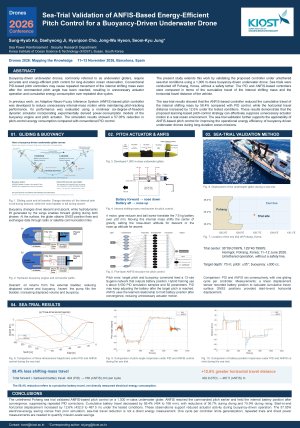
Buoyancy-driven underwater drones, commonly referred to as underwater gliders, require accurate and energy-efficient pitch control for long-duration ocean observation. Conventional PID-based pitch controllers may cause repeated movement of the internal shifting mass even after the commanded pitch angle has been reached, resulting in unnecessary actuator operation and cumulative energy consumption over repeated dive cycles.
In previous work, an Adaptive Neuro-Fuzzy Inference System (ANFIS)-based pitch controller was developed to reduce unnecessary internal-mass motion while maintaining pitch-tracking performance. Its performance was evaluated using a nonlinear six-degree-of-freedom dynamic simulator incorporating experimentally derived power-consumption models of the buoyancy engine and pitch actuator. The simulation results showed a 57.05% reduction in pitch-control energy consumption compared with conventional PID control.
The present study extends this work by validating the proposed controller under untethered sea-trial conditions using a 1,000 m class buoyancy-driven underwater drone. Sea trials were conducted off Pohang, Korea, without a safety tether. The PID and ANFIS-based controllers were compared in terms of the cumulative travel of the internal shifting mass and the horizontal travel distance of the vehicle.
The sea-trial results showed that the ANFIS-based controller reduced the cumulative travel of the internal shifting mass by 58.4% compared with PID control, while the horizontal travel distance increased by 12.6% under the tested conditions. These results demonstrate that the proposed learning-based pitch-control strategy can effectively suppress unnecessary actuator motion in a real ocean environment. The sea-trial validation further supports the applicability of ANFIS-based pitch control for improving the operational energy efficiency of buoyancy-driven underwater drones during long-duration ocean missions.
Keywords
Buoyancy-Driven Underwater Drone
Underwater Glider
Pitch Control
ANFIS
Energy Efficiency
Sea Trial
Poster
Drones2026_Poster_sung-hyub ko.pdf
Ultra-Wideband Localization in Forest Environments: Potential for Drone Applications
A First Step towards Noise-Aware Mission Planning through Acoustic Geofencing