Event submissions
Published
This submission belongs to the session S3. Guidance, Navigation, and Control of the event Drones 2026: Mapping the Knowledge
Published date
12 Nov, 2026
Citation
César Asensio, Esther García-Medina, Guillermo Arcas, A First Step towards Noise-Aware Mission Planning through Acoustic Geofencing, in Proceedings of Drones 2026: Mapping the Knowledge, Barcelona, 11 November–13 November 2026, MDPI: Basel, Switzerland
Share
Email
Facebook
Twitter
LinkedIn
A First Step towards Noise-Aware Mission Planning through Acoustic Geofencing

César Asensio 1
Esther García-Medina 1
Guillermo Arcas 1
1. Instrumentation and Applied Acoustics research group (I2A2), Universidad Politécnica de Madrid, 28031 Madrid
Abstract
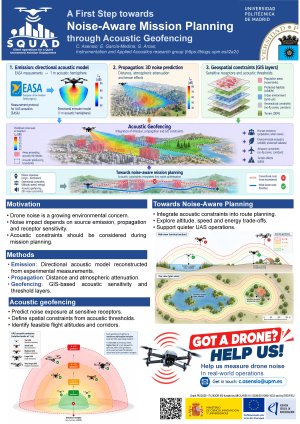
The widespread deployment of unmanned aerial systems (UASs) is usually discussed in terms of safety, autonomy, efficiency and airspace integration, while their acoustic impact is still rarely considered during mission planning. However, drone noise can produce immediate effects such as annoyance, sleep disturbance, communication masking and behavioural changes, and may also contribute to long-term impacts on both humans and wildlife, including habitat avoidance, chronic stress and reduced breeding success. For applications such as wildlife monitoring, delivery near protected areas, hospital logistics or flights over noise-sensitive communities, noise should be treated as an operational constraint rather than a post-operation assessment.
This paper presents a first step towards Noise-Aware Mission Planning by introducing an acoustic geoplanning framework based on Acoustic Geofencing. The proposed approach combines three components: (i) an experimentally derived acoustic emission model of the drone, (ii) a simplified sound propagation model to estimate the acoustic footprint along the flight path, and (iii) an acoustic zoning layer defining sensitive targets, threshold values and acoustic fences. Rather than relying solely on conventional geofencing, the framework evaluates candidate routes according to their predicted acoustic impact on nearby receptors, incorporating noise as an additional planning criterion.
The main objective is not to develop a complete autonomous path-planning algorithm, but to demonstrate that integrating acoustics into mission planning requires only a modest modelling effort while providing valuable operational information. Once available, this acoustic layer enables candidate routes to be evaluated before flight, facilitates comparison of alternative trajectories, and provides objective evidence of their acoustic compatibility with predefined thresholds. Beyond reducing disturbance to nearby communities and wildlife, the framework might also help avoid unnecessarily conservative restrictions where the predicted acoustic impact is negligible. The proposed approach therefore provides a practical bridge between drone development and environmental responsibility, supporting safer, more efficient and evidence-based UAS mission planning.
Keywords
Noise
mission planning
noise mapping
acoustic costs
environmental noise
Poster
Poster.pdf
Sea-Trial Validation of ANFIS-Based Energy-Efficient Pitch Control for a Buoyancy-Driven Underwater Drone
Genetic Algorithm for Terrain-Optimized Routing for UAV and eVTOL Corridor Navigation