Event submissions
Published
 10.3390/engproc2026163002 (registering DOI)
This submission belongs to the session S3. Sensor Networks, IoT, Smart Cities and Health Monitoring of the event The 13th International Electronic Conference on Sensors and Applications
Published date
13 Nov, 2026
Academic Editor
 Francisco Falcone
Citation
ALVIN PAUL, KASHINATH RAJ, SHELISHIYAH R, Skin Hydration Monitoring Using GSR Sensor, in Proceedings of The 13th International Electronic Conference on Sensors and Applications, 18 November–20 November 2026, MDPI: Basel, Switzerland, doi: 10.3390/engproc2026163002
Share
Email
Facebook
Twitter
LinkedIn
Skin Hydration Monitoring Using GSR Sensor

ALVIN PAUL 1
KASHINATH RAJ 1
SHELISHIYAH R 1
1. Department of Biomedical Engineering, SRM Institute of Science and Technology, Ramapuram, Chennai, Tamil Nadu, India
Abstract
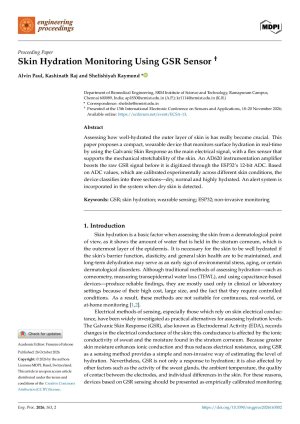
Skin hydration is one of the important factors deciding the natural elasticity, anti-aging and protective barrier of the skin. insufficient hydration can result in skin dryness, irritation, premature aging, and the skin becoming more vulnerable to environmental factors which may eventually lead to skin cancer. The continuous assessment of skin hydration is still challenging due to the limited portability and high cost of conventional measurement techniques. This study presents a wearable and non-invasive skin hydration monitoring system designed for real-time hydration assessment and early detection of dry skin conditions.
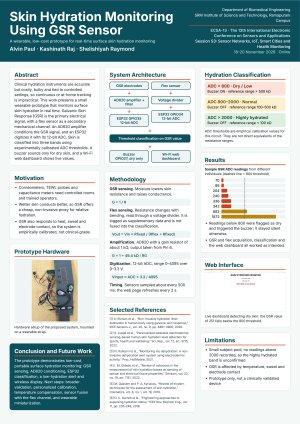
The proposed system uses a Galvanic Skin Response (GSR) sensor, flex sensor, AD620 instrumentation amplifier, ESP32 microcontroller, buzzer alert module, and wireless web-based monitoring interface. The GSR sensor sense the variations in skin conductance due to different skin moisture content in the stratum corneum, while the flex sensor provides supplementary skin mechanical information. An instrumental amplifier is used to improve signal quality in the signal conditioning stage. The acquired signals are amplified and conditioned using an AD620 instrumentation amplifier before digitized by the 12-bit analog-to-digital converter (ADC) of the ESP32, which produces output values ranging from 0 to 4095. ADC values below 800 indicated dry skin and low hydration, values between the range of 800 and 2000 represented normal hydration, and values above 2000 indicated highly hydrated skin. The experiment is demonstrated on ten people in different timing to validate the accuracy of the system. Under the observation of dermatologist, we have concluded the values and determination were accurate. Among the ten, 5 was detected dry skin who were actually dehydrated. 2 were detected highly hydrated and remaining 3 were normal skin hydration.
Keywords
Skin Hydration Monitoring
Galvanic Skin Response (GSR)
Wearable Biosensors
Non-Invasive Sensing
Electrodermal Activity
Real-Time Monitoring
Manuscript
Sciforum-193700engproc-163-00002.pdf
Poster
Skin_Hydration_Poster_ECSA-13_A1.pdf
Energy-Aware Fuzzy Clustering and Multi-Hop Relay Optimization for Underwater Wireless Sensor Networks
EcoRover: A Mobile IoT Multi-Sensor Platform for Environmental Risk Mapping in Smart Campus Scenarios