Event submissions
Published
 10.3390/engproc2026163003 (registering DOI)
This submission belongs to the session S3. Sensor Networks, IoT, Smart Cities and Health Monitoring of the event The 13th International Electronic Conference on Sensors and Applications
Published date
13 Nov, 2026
Academic Editor
 Francisco Falcone
Citation
Jordan Del Aguila, Jesús Alejandro Espinosa Gutiérrez, Dayron Camilo Echeverry Cortes, Hayleen Yaffrianny Mosquera Mosquera, Juan Carlos Morales Guerra, Jorge Andres Montoya Cardona, EcoRover: A Mobile IoT Multi-Sensor Platform for Environmental Risk Mapping in Smart Campus Scenarios, in Proceedings of The 13th International Electronic Conference on Sensors and Applications, 18 November–20 November 2026, MDPI: Basel, Switzerland, doi: 10.3390/engproc2026163003
Share
Email
Facebook
Twitter
LinkedIn
EcoRover: A Mobile IoT Multi-Sensor Platform for Environmental Risk Mapping in Smart Campus Scenarios

Jordan Del Aguila 1
Jesús Alejandro Espinosa Gutiérrez 2
Dayron Camilo Echeverry Cortes 1
Hayleen Yaffrianny Mosquera Mosquera 1
Juan Carlos Morales Guerra 1

Jorge Andres Montoya Cardona 1
1. Department of Electronics and Telecommunications, Engineering Faculty, Institución Universitaria ITM, Medellin, Colombia
2. Computer Systems Engineering Program, Department of Systems and Computing, Instituto Tecnológico de Morelia, Morelia 58120, Michoacán, Mexico
Abstract
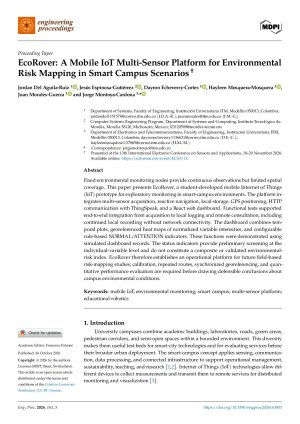
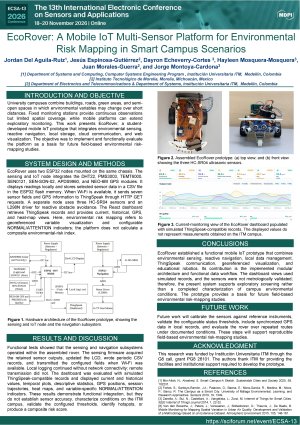
EcoRover is a low-cost mobile IoT prototype developed for environmental risk mapping in open and semi-outdoor smart-campus areas. The platform moves along predefined routes and records measurements at georeferenced points, allowing nearby zones to be compared instead of relying on a single fixed monitoring node. The rover is built on a small robotic cart and integrates environmental, particle, light, acoustic, position, and proximity sensing. A BME680 module records temperature, relative humidity, atmospheric pressure, and relative air-quality variations associated with volatile compounds. A PMS3003 sensor measures suspended particulate matter, while a TEMT6000 sensor and a KY-038 module register light intensity and local sound level, respectively. A NEO-6M GPS module is used only for open-area georeferencing, and the platform also includes an HC-SR04 ultrasonic sensor for obstacle detection, an APDS9960 module for proximity and gesture interaction, and a SEN0121 analog sensor as an additional environmental input. Local feedback is provided through an LCD display, LEDs, and buzzers. A servo-driven sensing head helps orient selected sensors toward the area being monitored. Measurements are transmitted through MQTT to a ThingSpeak channel, where time plots, gauges, and location-based visualizations support data review. Environmental risk is estimated using a simple rule-based index: each variable is compared with predefined reference ranges and classified into low, moderate, or high concern levels. The dashboard then combines these indicators to highlight zones where particulate concentration, relative air quality, noise, or lighting conditions should be reviewed. EcoRover is proposed as a practical smart-campus monitoring tool and as an educational platform for IoT, sensing, mobile robotics, and environmental data visualization.
Keywords
Mobile IoT
Environmental monitoring
Smart campus
Sensor fusion
Educational robotics
Manuscript
Sciforum-192625engproc-163-00003.pdf
Poster
Poster Eco-Rover.pdf
Skin Hydration Monitoring Using GSR Sensor
A Multifractal-Based Structural Representation of Retinal Images for Diabetic Retinopathy Analysis