Event submissions
Published
 10.3390/engproc2026163005 (registering DOI)
This submission belongs to the session S9. Student Session of the event The 13th International Electronic Conference on Sensors and Applications
Published date
13 Nov, 2026
Academic Editor
 Stefano Mariani
Citation
Bibek Gupta, Siwani Sah, Ayesha Dina, Luis Jaimes, Multi-Agent Prompting with In-Context Feedback for Cross-Modal Urban Event Chain Prediction, in Proceedings of The 13th International Electronic Conference on Sensors and Applications, 18 November–20 November 2026, MDPI: Basel, Switzerland, doi: 10.3390/engproc2026163005
Share
Email
Facebook
Twitter
LinkedIn
Multi-Agent Prompting with In-Context Feedback for Cross-Modal Urban Event Chain Prediction

Bibek Gupta 1
Siwani Sah 1
Ayesha Dina 1
Luis Jaimes 1
1. Department of Computer Science, Florida Polytechnic University, Lakeland, FL 33805, USA
Abstract
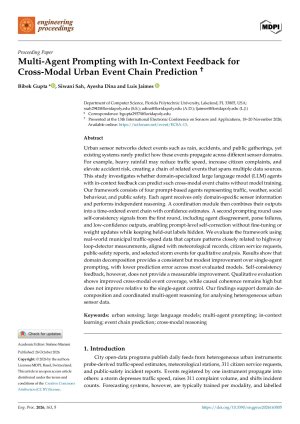
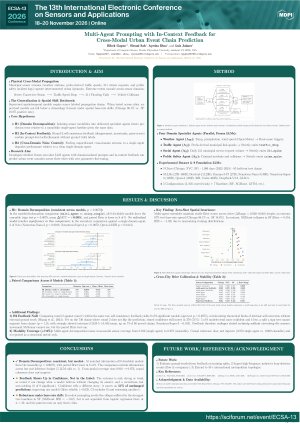
Urban sensor networks detect events such as rain, accidents, and public gatherings, yet existing systems cannot predict how these events propagate across different sensor domains. For example, heavy rainfall may reduce traffic speed, increase citizen complaints, and elevate accident risk, creating a chain of related events that spans multiple data sources. This study investigates whether domain-specialized large language model (LLM) agents with in-context feedback can predict such cross-modal event chains without model training.
Our framework consists of four prompt-based agents representing traffic, weather, social behavior, and public safety. Each agent receives only domain-specific sensor information and performs independent reasoning. A coordination module then combines their outputs into a time-ordered event chain with confidence estimates. To improve performance, prediction errors from each round are incorporated into subsequent prompts, enabling self-correction through in-context learning without fine-tuning or weight updates.
We evaluate the framework using real highway loop detector data aligned with meteorological records and selected storm events for qualitative analysis. Results show that multi-agent prompting with feedback achieves lower prediction error than both single-agent prompting and traditional baselines. Qualitative evaluation demonstrates improved causal coherence and event coverage. Our findings highlight the value of domain decomposition and feedback-driven reasoning for intelligent analysis of heterogeneous urban sensor data.
Keywords
Multi-Agent Prompting
Large Language Models
In-Context Feedback
Urban Sensor Networks
Cross-Modal Event Prediction
Smart Cities
Manuscript
Sciforum-192576engproc-163-00005.pdf
Poster
multi_agent_prompting_with_in_context_feedback_for_cross_modal_urban_event_chain_prediction_poster.pdf
A Multifractal-Based Structural Representation of Retinal Images for Diabetic Retinopathy Analysis
Developing a Low-Cost IoT Prototype for Non-Invasive Elderly Monitoring