Event submissions
Published
 10.3390/engproc2026163006 (registering DOI)
This submission belongs to the session S3. Sensor Networks, IoT, Smart Cities and Health Monitoring of the event The 13th International Electronic Conference on Sensors and Applications
Published date
13 Nov, 2026
Academic Editor
 Francisco Falcone
Citation
Danilo Arley Gomez Giraldo, Valerie Rios Lopez, Duver Alexis Arboleda Marles, Esteban Gonzalez Valencia, Jorge Andres Montoya Cardona, Developing a Low-Cost IoT Prototype for Non-Invasive Elderly Monitoring, in Proceedings of The 13th International Electronic Conference on Sensors and Applications, 18 November–20 November 2026, MDPI: Basel, Switzerland, doi: 10.3390/engproc2026163006
Share
Email
Facebook
Twitter
LinkedIn
Developing a Low-Cost IoT Prototype for Non-Invasive Elderly Monitoring

Danilo Arley Gomez Giraldo 1
Valerie Rios Lopez 2
Duver Alexis Arboleda Marles 3
Esteban Gonzalez Valencia 4

Jorge Andres Montoya Cardona 4
1. Department of Mechatronics and Electromechanics, Engineering Faculty, Institución Universitaria ITM, Medellin, Colombia
2. Department of Systems, Engineering Faculty, Institución Universitaria ITM, Medellin, Colombia
3. Department of Administrative Sciences, Economic and Administrative Sciences Faculty, Institución Universitaria ITM, Medellin, Colombia
4. Department of Electronics and Telecommunications, Engineering Faculty, Institución Universitaria ITM, Medellin, Colombia
Abstract
An increasing number of older adults spend long periods without direct supervision, increasing the risk of delayed responses to domestic emergencies. While camera-based monitoring systems have emerged as an obvious way to keep them watched, they introduce significant privacy concerns, especially in private spaces. To address this issue, we developed a low-cost IoT prototype called Radar-Cuidador. It provides non-invasive home monitoring by relying on simple sensors and cloud-based alert logic instead of video capture. The hardware design follows a distributed Hub-and-Spoke architecture, using an ESP32 serves as the main hub, integrating an HLK-LD2410C mmWave radar to measure presence, a MAX4466 microphone to capture acoustic anomalies, a BME280 environmental sensor, while for critical areas, an ESP8266 node acts as a spoke, using a Reed Switch to monitor door activity. The system triggers local hardware alerts and transmits data via Wi-Fi to ThingSpeak for automatic processing. Instead of complex image analysis, the alert logic relies on predefined thresholds programmed in MATLAB. During our initial tests, we deployed the hub in a living room and the spoke in a bathroom. This two-zone setup successfully validated the core functionality of detecting presence, logging environmental data, and identifying acoustic events like strong impacts. A complete home deployment would require the implementation of more nodes, however, this prototype proves you can build a working assisted-living system without sacrificing user privacy.
Keywords
Internet of Things
non-invasive monitoring
mmWave radar
assisted living
ThingSpeak
distributed architecture.
Manuscript
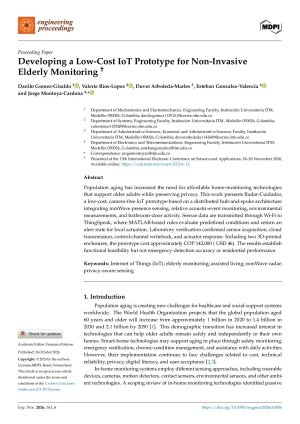
Sciforum-195341engproc-163-00006.pdf
Poster
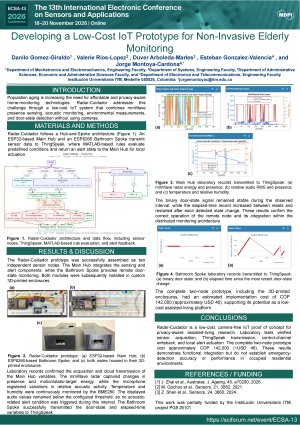
Poster_Radar-Cuidador.pdf
Multi-Agent Prompting with In-Context Feedback for Cross-Modal Urban Event Chain Prediction
Training a MobileNet CNN for simultaneous sensing of temperature and bending using experimental fiber specklegrams