Event submissions
Published
 10.3390/engproc2026163010 (registering DOI)
This submission belongs to the session S3. Sensor Networks, IoT, Smart Cities and Health Monitoring of the event The 13th International Electronic Conference on Sensors and Applications
Published date
13 Nov, 2026
Academic Editor
 Francisco Falcone
Citation
Athanasia Markou, Dimitrios Rimpas, Ioannis Chronis, George Hloupis, Ioannis Christakis, Low-Cost IoT-Based Smart Blood Collection Bag Monitoring and Agitation System for Real-Time Hemovigilance, in Proceedings of The 13th International Electronic Conference on Sensors and Applications, 18 November–20 November 2026, MDPI: Basel, Switzerland, doi: 10.3390/engproc2026163010
Share
Email
Facebook
Twitter
LinkedIn
Low-Cost IoT-Based Smart Blood Collection Bag Monitoring and Agitation System for Real-Time Hemovigilance

Athanasia Markou 1
Dimitrios Rimpas 2
Ioannis Chronis 2

George Hloupis 3
Ioannis Christakis 2
1. Mineschos Chemical Technical Company, Athens, Greece
2. Department of Electrical and Electronic Engineering, University of West Attica, P. Ralli & Thivon 250, 12244 Egaleo, Greece
3. Department of Surveying and Geoinformatics Engineering, University of West Attica, Agiou Spyridonos Str., 12243 Egaleo, Greece
Abstract
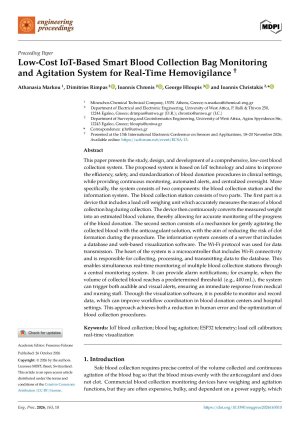
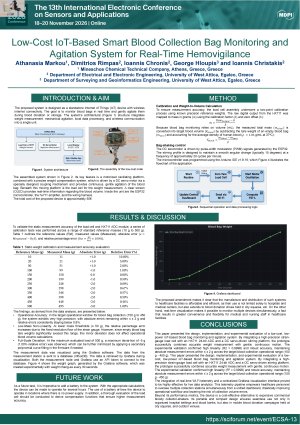
This paper presents the study, design, and development of a comprehensive, low-cost blood collection system. The proposed system is based on IoT technology and aims to improve the efficiency, safety, and standardization of blood donation procedures in clinical settings, while providing continuous monitoring, automated alerts, and centralized oversight. More specifically, the system consists of two components: the blood collection station and the information system. The blood collection station consists of two parts. The first part is a device that includes a load cell weighing unit which accurately measures the mass of a blood collection bag during collection. The device then continuously converts the measured weight into an estimated blood volume, thereby allowing for accurate monitoring of the progress of the blood donation. The second section consists of a mechanism for gently agitating the collected blood with the anticoagulant solution, with the aim of reducing the risk of clot formation during the procedure. The information system consists of a server that includes a database and web-based visualization software.The WiFi protocol was used for data transmission. The heart of the system is a microcontroller that includes Wi-Fi connectivity and is responsible for collecting, processing, and transmitting data to the database. This enables simultaneous real-time monitoring of multiple blood collection stations through a central monitoring system. It can provide alarm notifications, such as when the volume of collected blood reaches a predetermined threshold (e.g., 400 mL), the system can trigger both audible and visual alerts, ensuring an immediate response from medical and nursing staff. Through the visualization software, it is possible to monitor and record data, which can improve workflow coordination in blood donation centers and hospital settings. This approach achieves both a reduction in human error and the optimization of blood collection procedures.
Keywords
IoT (Internet of Things)
Blood collection monitoring
Load cell sensing
Real-time data visualization
Hemovigilance system
Manuscript
Sciforum-192618engproc-163-00010.pdf
Poster
ECSA13-Poster--Low-Cost IoT-Based Smart Blood Collection Bag Monitoring and Agitation System for Real-Time Hemovigilance.pdf
Performance Analysis of YOLO11 and YOLO26 for Electroluminescence-Based Photovoltaic Defect Detection Under Class-Imbalanced Conditions
Physical Unclonable Function Data Processing to Increase the Number of Challenge–Response Pairs in Wireless Sensor Network Applications