Event submissions
Published
 10.3390/engproc2026163011 (registering DOI)
This submission belongs to the session S3. Sensor Networks, IoT, Smart Cities and Health Monitoring of the event The 13th International Electronic Conference on Sensors and Applications
Published date
13 Nov, 2026
Academic Editor
 Francisco Falcone
Citation
Marco Grossi, Martin Omaña, Cecilia Metra, Physical Unclonable Function Data Processing to Increase the Number of Challenge–Response Pairs in Wireless Sensor Network Applications, in Proceedings of The 13th International Electronic Conference on Sensors and Applications, 18 November–20 November 2026, MDPI: Basel, Switzerland, doi: 10.3390/engproc2026163011
Share
Email
Facebook
Twitter
LinkedIn
Physical Unclonable Function Data Processing to Increase the Number of Challenge–Response Pairs in Wireless Sensor Network Applications

Marco Grossi 1

Martin Omaña 1
Cecilia Metra 1
1. Department of Electrical Energy and Information Engineering “Guglielmo Marconi” (DEI), University of Bologna, Bologna, Italy
Abstract
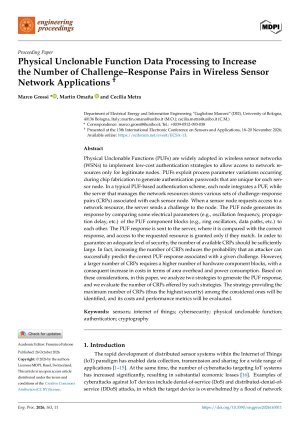
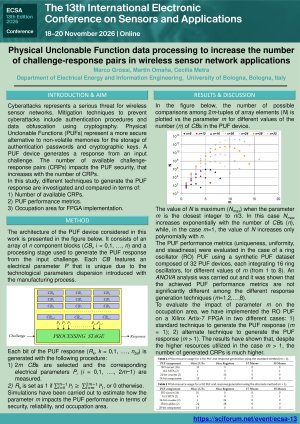
Physical Unclonable Functions (PUFs) are widely adopted in wireless sensor networks (WSNs) to implement low-cost authentication strategies to allow the access to the network resources only to legitimate nodes. PUFs exploit process parameter variations occurring during chip fabrication to generate authentication passwords that are unique for each sensor node. In a typical PUF-based authentication scheme, each node integrates a PUF, while the server that manages the network resources stores various sets of challenge-response pairs (CRPs) associated with each sensor node. When a sensor node requests access to a network resource, the server sends a challenge to the node. The PUF node generates its response by comparing to each other some electrical parameters (e.g., oscillation frequency, propagation delay, etc.) of the PUF component blocks (e.g., ring oscillators, data-paths, etc.). The PUF response is sent to the server, where it is compared with the correct response, and the access to the requested resource is granted only if they match. In order to guarantee an adequate level of security, the number of available CRPs should be sufficiently large. In fact, increasing the number of CRPs reduces the probability that an attacker can successfully predict the correct PUF response associated with a given challenge. However, a larger number of CRPs requires a higher number of hardware component blocks, with a consequent increase of costs in terms of area overhead and power consumption. Based on these considerations, in this paper we analyze different strategies to generate the PUF response, and we evaluate the number of CRPs offered by such strategies. The strategy providing the maximum number of CRPs (thus the highest security) among the considered ones will be identified, and its costs and performance metrics will be evaluated.
Keywords
sensors
internet of things
cybersecurity
physical unclonable function
authentication
cryptography
Manuscript
Sciforum-192071engproc-163-00011.pdf
Poster
ECSA-13 poster.pdf
Low-Cost IoT-Based Smart Blood Collection Bag Monitoring and Agitation System for Real-Time Hemovigilance