Event submissions
Published
 10.3390/engproc2026163013 (registering DOI)
This submission belongs to the session S9. Student Session of the event The 13th International Electronic Conference on Sensors and Applications
Published date
13 Nov, 2026
Academic Editor
 Stefano Mariani
Citation
Wendell Debulosan Agot, Jennifer Alturas Garin, Ma. Donaresci Yap Candel, Anna Monica Repunte Ondos, Bem Gumapac, Allan Josephus Maghuyop Bunga, IoT-Based Hydroponic Greenhouse with Automated Environmental Control and Machine Learning-Assisted Nutrient Optimization, in Proceedings of The 13th International Electronic Conference on Sensors and Applications, 18 November–20 November 2026, MDPI: Basel, Switzerland, doi: 10.3390/engproc2026163013
Share
Email
Facebook
Twitter
LinkedIn
IoT-Based Hydroponic Greenhouse with Automated Environmental Control and Machine Learning-Assisted Nutrient Optimization

Wendell Debulosan Agot 1
Jennifer Alturas Garin 1
Ma. Donaresci Yap Candel 1
Anna Monica Repunte Ondos 1

Bem Gumapac 1
Allan Josephus Maghuyop Bunga 1
1. Computer Engineering Department, College of Engineering, Architecture and Industrial Design, Bohol Island State University, Tagbilaran City 6300, Philippines
Abstract
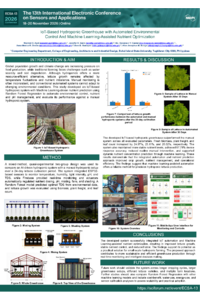
Managing manual hydroponic systems is often labor-intensive, requiring constant monitoring and frequent nutrient adjustment that challanges small scale growers. This study designed an IoT-based greenhouse system in Brgy. San Isidro, Talibon, Bohol, featuring automated environmental controls and machine learning-assisted nutrient optimization tailored for loose-leaf lettuce (Lactuca sativa var. crispa). The setup integrates temperature, humidity, light intensity, pH, and Total Dissolved Solids (TDS) sensors with actuators to regulate conditions in real time. Rather than relying on static baselines, a Random Forest Regression model dynamically estimates ideal TDS targets using live environmental data. To evaluate the system, we, the researchers, conducted a 30-day quasi-experimental comparison against a traditional manual hydroponic setup. Field results demonstrated significant agricultural improvements. The automated greenhouse boosted mean biomass to 119.74 grams with a 24.97% increase, average plant height to 13.00 centimeters with 23.11% increase, and leaf count to 13.13 per plant with 20.02% increase. Nutrient levels were also noticeably more stable, with the automated system maintaining a TDS standard deviation of 118.11 ppm versus 145.62 ppm in the manual setup. The hardware delivered a 97.78% correct actuator response rate, and the predictive model achieved a remarkable Mean Absolute Error of just 0.07 ppm. For growers, the most impactful change was a steep drop in manual labor. Cutting weekly maintenance from 3.5 hours down to just 0.5 hours, a reduction of 85.70%. These findings prove that automated, predictive nutrient management is highly viable for smallholder farming applications. Future development will focus on integrating solar power, testing alternative machine learning models, deploying advanced environmental sensors, and expanding technology to support a wider variety of crops.
Keywords
iot-based greenhouse
hydroponics
lettuce production
Random Forest Regression
nutrient optimization
automated dosing
environmental control
smart agriculture
Manuscript
Sciforum-188767engproc-163-00013.pdf
Poster
ECSA13_Poster.pdf
Few-Shot Probe Card Fault Diagnosis Using a Time-Series Foundation Model
Design and Development of a Low-Cost IoT-Based Real-Time Indoor Air Quality Monitoring and Alert System