Event submissions
Published
This submission belongs to the session 2. O – Organize: Workforce Development and Skills in the Construction Sector of the event The 1st International Online Conference on Sustainable Construction
Published date
13 Nov, 2026
Academic Editor
 Mehdi Amirkhani
Citation
ANASTASYA MARTINA, MUHAMAD ABDUH, BAMBANG TRIGUNARSYAH, IGOR MARTEK, REINI WIRAHADIKUSUMAH, BIEMO W SOEMARDI, The Need for a Comprehensive Study on Construction Competency Standards in Indonesia, in Proceedings of The 1st International Online Conference on Sustainable Construction, 18 November–20 November 2026, MDPI: Basel, Switzerland
Share
Email
Facebook
Twitter
LinkedIn
The Need for a Comprehensive Study on Construction Competency Standards in Indonesia

ANASTASYA MARTINA 1

MUHAMAD ABDUH 1
BAMBANG TRIGUNARSYAH 2

IGOR MARTEK 3
REINI WIRAHADIKUSUMAH 1
BIEMO W SOEMARDI 1
1. Construction and Management Infrastructure , Faculty of Civil Engineering, Bandung Institute of Technology, Bandung 40132, Indonesia
2. School of Property, Construction & Project Management , College of Social and Design, RMIT University, Melbourne, VIC 3000, Australia
3. School of Architecture and Built Environment, Faculty of Science, Engineering and Built Environment, Geelong Waterfront Campus, Deakin University, Geelong, Victoria, VIC 3220, Australia
Abstract
Indonesia's construction industry is undergoing a fundamental global shift driven by digitalization, Industry 4.0 technologies, increasing complexity of processes and information, industry collaboration, complex public procurement and sustainability demands. However, the existing Indonesian National Work Competency Standards (SKKNI) as a formal regulation show significant gaps in addressing evolving industry needs.
This study examines the urgent rethinking of the Indonesian construction standard competency (SKKNI), guided to address the critical gaps in Indonesia's current construction competency standards framework, and what comprehensive research agenda is needed to address emerging future competence requirements for future research.
A comprehensive search strategy was employed across peer-reviewed publication and academic databases covering the period of last decade. Inclusion criteria (focus on Indonesian construction regulatory documents including UU 2/2017 which replaced UU 18/1999, Perpres 8/2012, PP 22/2020 and PP 14/2021, and unit competencies in SK DJBK 114/2024 for citizens and SE 76/2024 for foreign experts) were examined to assess the Indonesian National Work Competency Standards (SKKNI) framework. Another 20 papers were selected for depth analysis. Thematic analysis was used to examine multiple competency standards frameworks from Malaysia, Singapore, and Australia, investigating how these countries have approached standard competency frameworks and emerging future competence initiatives.
The findings indicate that SKKNI provides limited coverage of critical future competencies and the SKKNI framework exhibits critical gaps including education-occupation misalignment (G-1), absence of productivity measurement standards (G-5), lack of standards for emerging job positions (G-7), and supply-driven LSP-dependent certification (G-2). These findings underscore the urgent need for a comprehensive study to review Indonesia's construction competency standards, integrate future construction competencies, and align education–industry–policy frameworks. Understanding these gaps and needs has important implication for authors with a doctoral research background for transforming Indonesia’s construction industry by addressing the demand-driven standard competencies.
Keywords
Indonesia
Construction
Competency Standard
SKKNI
Gaps
Poster
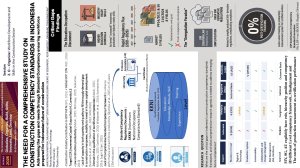
Poster GoBuild aa.pdf
Is education and training delivering an AI-ready construction workforce? Evidence from AI deployment and training provision
Ergonomic Risk Assessment in Immersive Virtual Reality-Based Modular Construction Training: A Preventive Approach for Onsite Assembly Safety