Event submissions
Published
 10.3390/engproc2026163017 (registering DOI)
This submission belongs to the session S2. Physical Sensors of the event The 13th International Electronic Conference on Sensors and Applications
Published date
13 Nov, 2026
Academic Editor
 Jean-Marc Laheurte
Citation
Jânio Anselmo, Douglas Molter Ferreira, Juan Alberto Gonzalez Cuevas, Julio César dos Santos, Gustavo Ferreira Nicoluzzi, Guilherme Brasil Pintarelli, Daniela Ota Hisayasu Suzuki, Electrical Impedance Spectroscopy Study of Bubble-Associated Interfacial Changes in Physiological Saline Solution Under DC Excitation, in Proceedings of The 13th International Electronic Conference on Sensors and Applications, 18 November–20 November 2026, MDPI: Basel, Switzerland, doi: 10.3390/engproc2026163017
Share
Email
Facebook
Twitter
LinkedIn
Electrical Impedance Spectroscopy Study of Bubble-Associated Interfacial Changes in Physiological Saline Solution Under DC Excitation

Jânio Anselmo 1
Douglas Molter Ferreira 1
Juan Alberto Gonzalez Cuevas 1
Julio César dos Santos 1
Gustavo Ferreira Nicoluzzi 1

Guilherme Brasil Pintarelli 1
Daniela Ota Hisayasu Suzuki 1
1. Biomedical Engineering Institute (IEB-UFSC), Federal University of Santa Catarina (UFSC), Campus Universitário Reitor João David Ferreira Lima, Trindade, Florianópolis, SC 88040-900, Brazil
Abstract
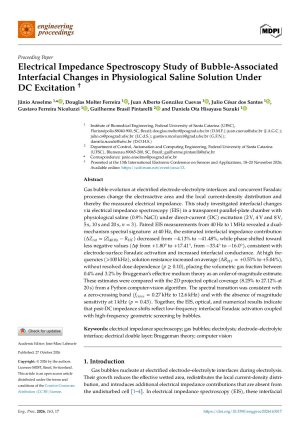
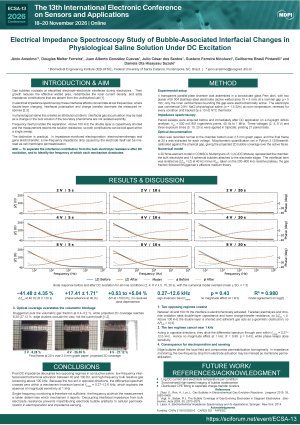
Electrolysis-induced gas bubbles at electrode--electrolyte interfaces can distort local electric-field distributions, reduce the effective wetted electrode area, and alter impedance in pulsed electric field (PEF) systems. This study proposes a time-resolved methodology to identify electrolysis onset and bubble dynamics by combining ramp-potential excitation, broadband impedance measurements, and finite-element numerical simulations in COMSOL Multiphysics. Impedance spectra are acquired before and after each electrical stimulus from 40 Hz to 10 MHz, while the numerical model estimates electric-field redistribution, current-density perturbations, and local conductivity changes around gas inclusions. The temporal evolution of impedance magnitude, phase angle, and equivalent resistive--capacitive behavior is analyzed to distinguish electrode polarization, bulk electrolyte conduction, and bubble-related interfacial effects. The anticipated impedance changes are frequency-dependent deviations, mainly at low and intermediate frequencies, associated with active-area reduction, current-path redistribution, bubble coverage, and apparent variations in interfacial resistance and capacitance. This response may support indirect discrimination of bubble nucleation, growth, detachment, and relaxation after excitation, while clarifying how void-induced conductivity losses interact with interfacial charge-transfer kinetics. This integrated assessment also helps define measurement windows less affected by purely capacitive transients. By linking experimental impedance trends with numerical field maps, the framework can provide physically grounded criteria for safer PEF parameter selection, electrode-geometry optimization, and future real-time monitoring in electrochemical, bioelectronic, and electroporation-based systems.
Keywords
pulsed electric fields
electrolysis
gas bubbles
electrochemical impedance spectroscopy
finite element method
COMSOL Multiphysics
electrode-electrolyte interface
temporal impedance
Manuscript
Sciforum-192568engproc-163-00017.pdf
Poster
poster_ECSA13_en.pdf
Metrological Validation of a Low-Cost Microcontroller-Based Reference Device for Neonatal Incubator Calibration
Frequency Modulation Self-Mixing Interferometer: Architecture and Performances