Event submissions
Published
 10.3390/engproc2026163021 (registering DOI)
This submission belongs to the session S6. Electronic Sensors, Devices, and Systems of the event The 13th International Electronic Conference on Sensors and Applications
Published date
13 Nov, 2026
Academic Editor
 Jean-Marc Laheurte
Citation
Guilherme Augusto Fincatti da Silva, Fernando Henrique Pimentel Rondon de Assis, Pedro Junior, Paulo Monson, Fabio Dotto, Hybrid Edge-Cloud Architecture for Acoustic Emission Monitoring in Industry 4.0, in Proceedings of The 13th International Electronic Conference on Sensors and Applications, 18 November–20 November 2026, MDPI: Basel, Switzerland, doi: 10.3390/engproc2026163021
Share
Email
Facebook
Twitter
LinkedIn
Hybrid Edge-Cloud Architecture for Acoustic Emission Monitoring in Industry 4.0

Guilherme Augusto Fincatti da Silva 1
Fernando Henrique Pimentel Rondon de Assis 1
Pedro Junior 1
Paulo Monson 1

Fabio Dotto 1
1. Department of Electrical and Computer Engineering (SEL), São Carlos School of Engineering (EESC), USP - University of São Paulo, São Carlos, 13566-590, Brazil
Abstract
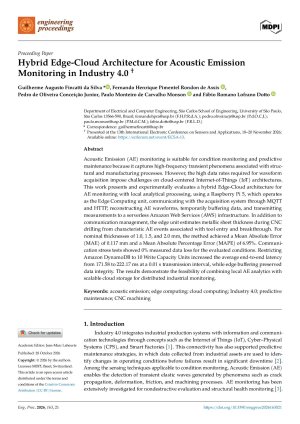
Within Industry 4.0 environments, Acoustic Emission (AE) signal monitoring are important in predictive maintenance applications, and with the advances of cloud computing, it can be even more fundamental because of the capability of spotting problems at every moment. However, the high sampling frequencies required to capture AE events produce large amounts of data, and the harsh conditions present in most industries make it hard to keep continuous transmission to cloud infrastructures due to bandwidth and latency limitations. With these challenges the industry had motivations to adopt distributed processing strategies capable of reducing communication overhead while preserving signal integrity and enabling real-time analysis.
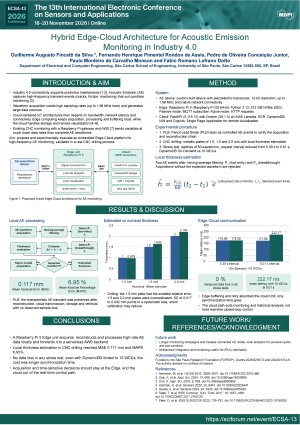
This paper proposes a hybrid Edge-Cloud architecture for the acquisition, processing, storage, and visualization of AE signals. The edge layer, implemented on a Raspberry Pi 5, acts as a local server communicating with the AE sensor and the cloud environment using MQTT and HTTP protocols in different situations. After signal acquisition and pre-processing, algorithms for sheet thickness classification based on AE signals were implemented at the edge layer. Pre-processed data are transmitted to a Serverless cloud infrastructure based on Amazon Web Services (AWS), where the data is stored in a No-SQL database. After storage, the processed signal can be visualized and analyzed via a single-page application, hosted on AWS, using services like AWS Lambda and AWS Amplify.
Practical tests like network stress tests indicated zero packet loss even at high transmission frequencies, demonstrating the importance and good implementation of retry queues. Furthermore, practical tests were done in real world situations to validate the edge and cloud layers functionality in end-to-end processes. The obtained results suggest that the proposed architecture represents a valid and innovative approach for high-frequency industrial monitoring systems, and also, the architecture enables flexible deployment strategies for distributed sensing applications across industrial environments.
Keywords
Acoustic Emission Monitoring
Edge-Cloud Architecture
Predictive Maintenance
Industry 4.0
Serverless Computing
Manuscript
Sciforum-192208engproc-163-00021.pdf
Poster
ECSA-13_Poster_submission_192208.pdf
Sensitive Electrochemical and Acoustic Detection of Myelin Basic Protein Using Antifouling Self-Assembled Monolayers and DNA Aptamer-Based Recognition
Step-by-step algorithm for focal length optimization in a varifocal Shack-Hartmann wavefront sensor