Event submissions
Published
This submission belongs to the session 3. B – Build: Sustainable Building Practices of the event The 1st International Online Conference on Sustainable Construction
Published date
13 Nov, 2026
Academic Editor
 Biemo Woerjanto Soemardi
Citation
Imran Jebarah, Aligning Early Design and Construction Decisions with Lifecycle Asset Value: A Knowledge-Based Framework for Sustainable Real Estate Development, in Proceedings of The 1st International Online Conference on Sustainable Construction, 18 November–20 November 2026, MDPI: Basel, Switzerland
Share
Email
Facebook
Twitter
LinkedIn
Aligning Early Design and Construction Decisions with Lifecycle Asset Value: A Knowledge-Based Framework for Sustainable Real Estate Development

Imran Jebarah 1
1. McWhorter School of Building Science, College of Architecture, Design and Construction, Auburn University, Auburn, 36830, USA
Abstract
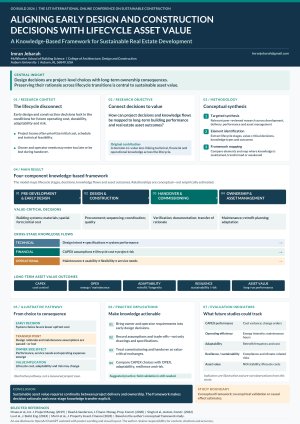
Introduction: Early design and construction decisions strongly influence lifecycle building performance, sustainability, and real estate asset value. However, these decisions are often made within fragmented project environments where technical, financial, and operational knowledge are not consistently connected to long-term ownership and asset-management objectives. This study develops a knowledge-based framework for explaining how value-critical project decisions shape lifecycle outcomes.
Methods: A conceptual framework-development approach was used, supported by a targeted synthesis of peer-reviewed literature in real estate development, property and asset management, project delivery, building performance, and knowledge management. The analysis identified recurring development stages, decision points, knowledge categories, and asset-value outcomes. These elements were then compared and mapped to clarify how knowledge is generated, transferred, transformed, or weakened across project transitions.
Results: The study produced a four-component framework linking: (1) lifecycle stages from pre-development and design through construction, handover, operation, and asset management; (2) decisions concerning building systems, materials, spatial configuration, procurement, sequencing, commissioning, and maintenance; (3) technical, financial, and operational knowledge flows; and (4) outcomes including capital expenditure performance, operating efficiency, adaptability, resilience, sustainability, and long-term asset value. The framework’s originality lies in positioning design and construction decisions as asset-value mechanisms rather than isolated technical choices. It also identifies handover and commissioning as critical points where incomplete knowledge transfer can weaken lifecycle performance.
Conclusions: Sustainable construction requires more than improving individual design choices; it depends on maintaining continuity between project delivery decisions and ownership objectives. Earlier owner and asset-manager involvement, explicit documentation of decision rationale, and structured transfer of technical, financial, and operational knowledge can improve the alignment between construction decisions, lifecycle sustainability, and long-term asset performance.
Keywords
sustainable construction
lifecycle asset value
design decision-making
knowledge management
real estate development
Poster
GO_BUI~1.PDF
Stakeholder Networks in Off-site Construction Supply Chain: A Systematic Literature Review
Place-Based Sustainability in Architecture: Deriving Climate-Responsive Design Principles from Traditional Basalt Buildings in Kars, Türkiye