Event submissions
Published
This submission belongs to the session 3. B – Build: Sustainable Building Practices of the event The 1st International Online Conference on Sustainable Construction
Published date
13 Nov, 2026
Academic Editor
 Muhamad Abduh
Citation
Imran Jebarah, Mapping Design for Disassembly and Material Reuse Research in the Built Environment: A Bibliometric and Thematic Analysis, in Proceedings of The 1st International Online Conference on Sustainable Construction, 18 November–20 November 2026, MDPI: Basel, Switzerland
Share
Email
Facebook
Twitter
LinkedIn
Mapping Design for Disassembly and Material Reuse Research in the Built Environment: A Bibliometric and Thematic Analysis

Imran Jebarah 1
1. McWhorter School of Building Science, College of Architecture, Design and Construction, Auburn University, Auburn, AL 36849, USA
Abstract
Introduction: Design for disassembly (DfD) is increasingly promoted as a pathway to retain building components, reduce construction and demolition waste, and support circular material flows. However, the research landscape remains fragmented across structural systems, environmental assessment, digital tools, and implementation studies. This study maps the development, methods, design strategies, and reported outcomes of DfD and material-reuse research in the built environment.
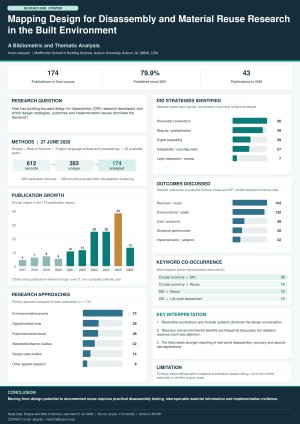
Methods: Scopus and Web of Science were searched through 27 June 2026. After document-type and English-language filtering, 612 article and conference/proceedings records were merged; 229 duplicates were removed, and 383 unique records were screened by title and abstract. A final corpus of 174 directly relevant publications was analyzed using descriptive bibliometrics, author-keyword co-occurrence, and structured abstract-based thematic coding.
Results: Research expanded rapidly, with 139 publications (79.9%) appearing since 2021 and a peak of 43 in 2025. Environmental or economic assessment was the leading research approach (73 studies; 42.0%), followed by digital or methodological tools (29; 16.7%) and experimental or structural testing (28; 16.1%). Reversible connections (56; 32.2%) and modular or prefabricated strategies (49; 28.2%) were the most frequent design interventions, whereas digital information and traceability appeared in 29 studies (16.7%) and layer separation or accessibility in only seven (4.0%). Recovery or reuse outcomes were addressed in 143 studies (82.2%) and environmental or waste outcomes in 132 (75.9%), but implementation and adoption appeared in only 32 (18.4%).
Conclusions: DfD research is growing quickly but remains weighted toward projected environmental and recovery benefits rather than implementation evidence. Future work should prioritize standardized assessment, interoperable material information, practical disassembly validation, and documented component reuse across multiple building lifecycles.
Keywords
Design for disassembly
material reuse
circular construction
bibliometric analysis
built environment
Poster
GO_BUILD_2026_DfD_Flash_Poster_Jebarah.pdf
From Authoritarian to Permissive: Creating a Place Identity at the Diminishing Historical and Cultural Landscape of Sylhet's Old Central Jail, Bangladesh
A Morphological Approach to Infill Design and Socio-Spatial Erosion in Oradea, Romania: a sustainable cultural perspective