Event submissions
Published
 10.3390/engproc2026163022 (registering DOI)
This submission belongs to the session S2. Physical Sensors of the event The 13th International Electronic Conference on Sensors and Applications
Published date
13 Nov, 2026
Academic Editor
 Jean-Marc Laheurte
Citation
Vladimir Toporovsky, Ilya Galaktionov, Step-by-step algorithm for focal length optimization in a varifocal Shack-Hartmann wavefront sensor, in Proceedings of The 13th International Electronic Conference on Sensors and Applications, 18 November–20 November 2026, MDPI: Basel, Switzerland, doi: 10.3390/engproc2026163022
Share
Email
Facebook
Twitter
LinkedIn
Step-by-step algorithm for focal length optimization in a varifocal Shack-Hartmann wavefront sensor

Vladimir Toporovsky 1,2

Ilya Galaktionov 1,3
1. Quantum Center, Moscow Technical University of Communications and Informatics, Moscow, 111024, Russia
2. Department of Higher Mathematics, MIREA – Russian Technological University, 78 Vernadsky Avenue, Moscow 119454, Russia
3. Physics Department, Moscow Polytechnic University, Moscow, 107023, Russia
Abstract
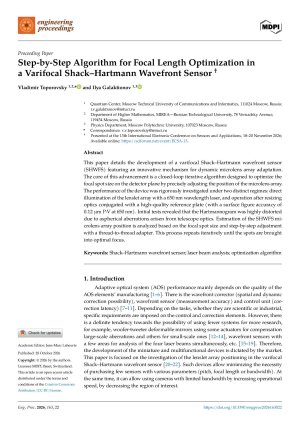
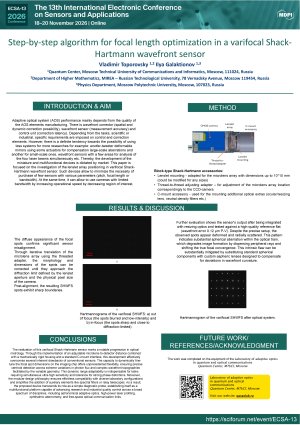
This paper details the development of a varifocal Shack-Hartmann wavefront sensor (SHWFS) featuring an innovative mechanism for dynamic microlens array adaptation. The core of this advancement is a closed-loop iterative algorithm designed to optimize the focal spot size on the detector plane by precisely adjusting the position of the microlens array.
The performance of the device was rigorously investigated under two distinct regimes: direct illumination of the lenslet array with a 650 nm wavelength laser, and operation after resizing optics conjugated with a high-quality reference plate (with a surface figure accuracy of 0.12 μm P-V at 650 nm). Initial tests revealed that the Hartmannogram was highly distorted due to aspherical aberrations arisen from telescope optics. Estimation of the SHWFS microlens array is analyzed on the focal spots size and step-by-step adjustment with thread-to-thread adapter. This process repeats iteratively until the spots are brought into optimal focus.
In summary, the integration of this adaptive algorithm represents a significant leap forward in optical metrology. By enabling dynamic optimization, this work successfully addresses key limitations of traditional sensors. The ability to dynamically adjust the focal length provides unparalleled flexibility, ensuring accurate measurements across a vast range of light intensities and wavefront aberration amplitudes. This adaptability is crucial for applications demanding both high sensitivity and a large dynamic range, positioning the proposed sensor as a versatile platform for research in fields from astronomical adaptive optics to ophthalmic diagnostics.
Keywords
Shack-Hartmann sensor
laser beam wavefront
optimization algorithm
Manuscript
Sciforum-198906engproc-163-00022.pdf
Poster
Shack-Hartmann.pdf
Hybrid Edge-Cloud Architecture for Acoustic Emission Monitoring in Industry 4.0
Electrochemical Monitoring and Kinetic Modeling of the Enzymatic Hydrolysis of Tapioca Starch