Event submissions
Published
 10.3390/engproc2026163023 (registering DOI)
This submission belongs to the session S1. Chemo- and Biosensors of the event The 13th International Electronic Conference on Sensors and Applications
Published date
13 Nov, 2026
Academic Editor
 Stefano Mariani
Citation
Emurigho Anthony Tega, Loc Thai Nguyen, Wai Prathumpai, Electrochemical Monitoring and Kinetic Modeling of the Enzymatic Hydrolysis of Tapioca Starch, in Proceedings of The 13th International Electronic Conference on Sensors and Applications, 18 November–20 November 2026, MDPI: Basel, Switzerland, doi: 10.3390/engproc2026163023
Share
Email
Facebook
Twitter
LinkedIn
Electrochemical Monitoring and Kinetic Modeling of the Enzymatic Hydrolysis of Tapioca Starch

Emurigho Anthony Tega 1
Loc Thai Nguyen 2

Wai Prathumpai 3
1. Department of Food Science and Technology, School of Industrial and Applied Science, Federal Polytechnic Nekede, P.M.B. 1036, Owerri, Imo State, Nigeria
2. Department of Food Engineering and Bioprocess Technology, Asian Institute of Technology, Khlong Luang 12120, Pathum Thani, Thailand
3. National Center for Genetic Engineering and Biotechnology, National Science and Technology Development Agency, Klong Luang, 12120, Pathumthani, Thailand
Abstract
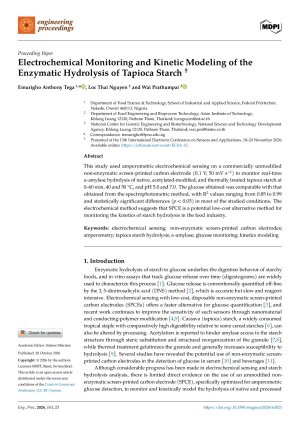
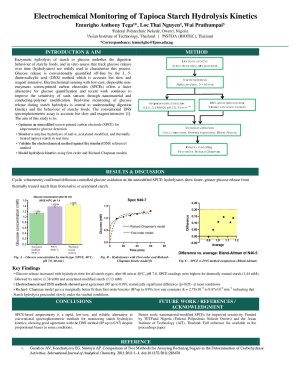
In this study, an electrochemical method was used for real-time monitoring of the hydrolysis of native, acetylated, modified, and thermally treated tapioca starch using an amperometric technique. The measurements were performed with low-cost screen-printed electrodes at an optimal potential of 0.1 V and a scan rate of 50 mVs-1. The tapioca starches were hydrolyzed by alpha amylase enzyme at reaction times ranging from 0 to 60 min, temperatures of 40°C and 50°C, and pH values of 5.0 and 7.0, respectively. This approach was found to yield glucose concentrations comparable with those obtained by the standard chemical method (spectrophotometry measurement) with no statistically significant difference (p< 0.05) in most of the studied conditions. The kinetics modeling of the enzymatic hydrolysis that yielded glucose revealed that both the first-order kinetic model and Chapman-Richard’s function model had good predictions of the hydrolysis process. Although both models successfully captured the nonlinear complexities involved in the electro oxidation process of glucose at the different temperatures and pH values, the Chapman-Richard function model demonstrated a better prediction than the first-order kinetic model. The findings revealed that applying electrochemical sensing with kinetic models has the potential to help develop rapid and inexpensive methods for in process monitoring of the hydrolysis of starch-based product in the food industry.
Keywords
Electrochemical sensor
amperometry
tapioca starch
enzymatic hydrolysis
kinetics modelling.
Manuscript
Sciforum-181577engproc-163-00023.pdf
Poster
Poster_Proceeding paper1.pdf
Step-by-step algorithm for focal length optimization in a varifocal Shack-Hartmann wavefront sensor
A Portable RGB Color-Sensor Platform for On-Farm Prediction of Sheep Pregnancy and Litter Size