Event submissions
Published
This submission belongs to the session 3. B – Build: Sustainable Building Practices of the event The 1st International Online Conference on Sustainable Construction
Published date
13 Nov, 2026
Academic Editor
 Chris Chow
Citation
Alexandros Loutsioli Daskalakis, Influence of Design Complexity on Energy Demand in Window Assembly, in Proceedings of The 1st International Online Conference on Sustainable Construction, 18 November–20 November 2026, MDPI: Basel, Switzerland
Share
Email
Facebook
Twitter
LinkedIn
Influence of Design Complexity on Energy Demand in Window Assembly

Alexandros Loutsioli Daskalakis 1
1. Virtual Construction Lab LP, 260 West 39th Street, New York, 10018, USA
Abstract
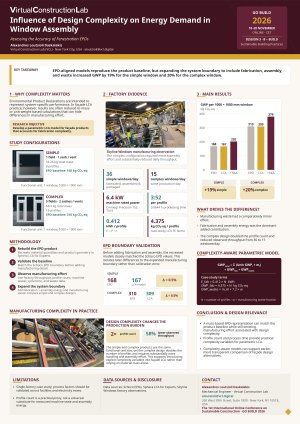
Lifecycle impact assessment of façade systems is challenging due to uncertainties in fabrication processes, assembly energy requirements, and modeling assumptions. Conventional lifecycle assessment (LCA) methods frequently estimate fabrication energy based solely on material mass, neglecting the effects of system configuration and manufacturing complexity. Although these simplifications facilitate standardization, they may introduce substantial inaccuracies when applied to complex façade systems.
This research examines the influence of design complexity on fabrication energy demand and associated Global Warming Potential (GWP) in aluminum façade products. A process-based modeling approach was developed, utilizing data from Sphera LCA for Experts and on-site observations at a Skyline Windows manufacturing facility. Comparative analysis of façade systems with varying complexity indicates that fabrication energy is more significantly affected by the number of discrete components and machining operations than by material mass alone. The findings reveal that simplified mass-based methods can both overestimate and underestimate fabrication impacts depending on system configuration, with the greatest discrepancies observed in more complex assemblies. These results underscore limitations in current Environmental Product Declaration (EPD) methodologies and demonstrate the necessity of incorporating process-level parameters into LCA models. This framework offers a more accurate method for evaluating fabrication impacts in façade systems and enhances the reliability of lifecycle assessments for complex building components.
Keywords
Life Cycle Assessment
Case Study
Fabrication
Assembly
Building Facade Systems
Poster
GO_BUILD_2026_Poster_147628_.pdf
Comparative Analysis of Electrical Energy Consumption in Buildings with Glass Façades Using 6D BIM: A Case Study of the BRT Electric Center Project
OPTIMIZING DECARBONIZATION AND OCCUPANT WELL-BEING IN DEEP RENOVATION WITH THRIVE: A NEB & LEEDv5 INTEGRATED ASSESSMENT FRAMEWORK