Event submissions
Published
 10.3390/engproc2026163028 (registering DOI)
This submission belongs to the session S4. Sensors and Artificial Intelligence of the event The 13th International Electronic Conference on Sensors and Applications
Published date
13 Nov, 2026
Academic Editor
 Francisco Falcone
Citation
Arif Hajiyev, Zeki Yetgin, Sabina Aghazada, Low-Rate Cross-View Map Updates for Drift-Bounded Fixed-Wing VIO in GNSS-Denied Missions, in Proceedings of The 13th International Electronic Conference on Sensors and Applications, 18 November–20 November 2026, MDPI: Basel, Switzerland, doi: 10.3390/engproc2026163028
Share
Email
Facebook
Twitter
LinkedIn
Low-Rate Cross-View Map Updates for Drift-Bounded Fixed-Wing VIO in GNSS-Denied Missions

Arif Hajiyev 1
Zeki Yetgin 1
Sabina Aghazada 2
1. Department of Computer Engineering, Faculty of Engineering, Mersin University, Ciftlikkoy Campus, 33343 Yenisehir, Mersin, Türkiye
2. School of Information Technology, National Aviation Academy, Mardakan Avenue 30, AZ1045 Baku, Azerbaijan
Abstract
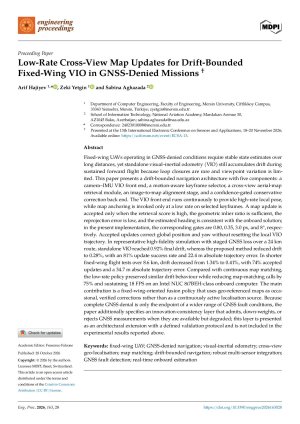
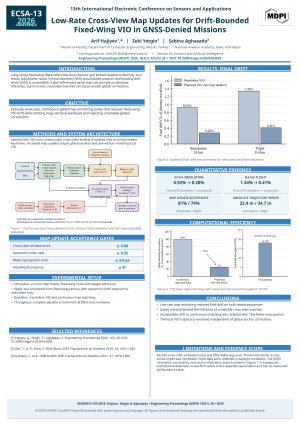
Fixed-wing UAVs operating in GNSS-denied conditions require stable state estimates over long distances, yet standalone visual-inertial odometry (VIO) still accumulates drift during sustained forward flight because loop closures are rare and viewpoint variation is limited. This paper presents a drift-bounded navigation architecture with five components: a camera–IMU VIO front end, a motion-aware keyframe selector, a cross-view aerial-map retrieval module, an image-to-map alignment stage, and a confidence-gated conservative correction back end. The VIO front end runs continuously to provide high-rate local pose, while map anchoring is invoked only at low rate on selected keyframes. A map update is accepted only when the retrieval score is high, the geometric inlier ratio is sufficient, the reprojection error is low, and the estimated heading is consistent with the onboard solution; in the present implementation, the corresponding gates are 0.80, 0.35, 3.0 px, and 8°, respectively. Accepted updates correct global position and yaw without resetting the local VIO trajectory.
In representative high-fidelity simulation with staged GNSS loss over a 24 km route, standalone VIO reached 0.92% final drift, whereas the proposed method reduced drift to 0.28%, with an 81% update success rate and 22.4 m absolute trajectory error. In shorter fixed-wing flight tests over 8.6 km, drift decreased from 1.34% to 0.41%, with 74% accepted updates and 34.7 m absolute trajectory error. Compared with continuous map matching, the low-rate policy preserved similar drift behavior while reducing map-matching calls by 75% and sustaining 18 FPS on an Intel NUC 8i7BEH-class onboard computer. The main contribution is a fixed-wing-oriented fusion policy that uses geo-referenced maps as occasional, verified corrections rather than as a continuously active localization source.
Keywords
Fixed-wing UAV
GNSS-denied navigation
visual-inertial odometry
cross-view geo-localization
map matching
drift-bounded navigation
real-time onboard estimation
Manuscript
Sciforum-194419engproc-163-00028.pdf
Poster
ECSA13_Hajiyev_Poster_2026.pdf
A Graphene-Based Tunable Metamaterial Absorber with Transmission in the Terahertz Band for Refractive Index Sensing
Smart Fog Irrigation for Fig Propagation: An IoT LoRaWan Closed-Loop Microclimate System