Event submissions
Published
This submission belongs to the session 4. U – Unit: Resilient Infrastructure and Disaster Management of the event The 1st International Online Conference on Sustainable Construction
Published date
13 Nov, 2026
Academic Editor
 Yibin Ao
Citation
Muchlis Abri Putra, Agus Suryono, Material Supply Chain Disruption and Mitigation in Extreme Remote Construction: An Empirical Case Study from a Mining-Concession Infrastructure Project in Papua, Indonesia., in Proceedings of The 1st International Online Conference on Sustainable Construction, 18 November–20 November 2026, MDPI: Basel, Switzerland
Share
Email
Facebook
Twitter
LinkedIn
Material Supply Chain Disruption and Mitigation in Extreme Remote Construction: An Empirical Case Study from a Mining-Concession Infrastructure Project in Papua, Indonesia.

Muchlis Abri Putra 1
Agus Suryono 2
1. Department of Civil Engineering, Faculty of Engineering, Universitas Muhammadiyah Surakarta, Jl. Ahmad Yani No. 157, Pabelan, Kartasura, Sukoharjo 57169, Central Java, Indonesia
2. PT PP (Persero) Tbk, Plaza PP, Jl. TB Simatupang No. 57, Pasar Rebo, East Jakarta 13760, Indonesia
Abstract
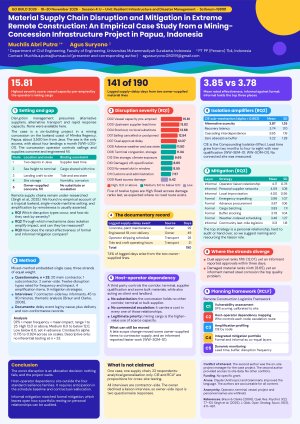
Construction supply chains in extreme remote environments operate without the supplier depth and transport redundancy that mainstream resilience theory assumes, and without the capacity to mount a rapid response. Empirical evidence from such settings is thin. This study characterises material supply chain disruption and mitigation in an infrastructure project inside a mining concession on the lowland coast of Mimika Regency, Papua, Indonesia, where site access is exclusively maritime.
The study uses a mixed-method embedded single-case design with three strands of equal analytical weight. A structured questionnaire completed by all 23 project personnel covered twelve disruption types rated separately for frequency and impact (24-indicator scale, Cronbach’s α = 0.924), four amplification items and nine mitigation strategies. We coded seven contractor-side key-informant interviews thematically and reconstructed the project delay event log by cause. We computed severity as DPS = F̄ × Ī.
Five of twelve disruption types fall in the High severity band. The most severe is pre-emption of vessel capacity by the host operator’s own mining cargo (DPS = 15.81), an allocation decision rather than a performance failure. The delay log records 190 supply-related delay days, of which 141 (74 per cent) arise from two owner-supplied bulk material lines. We name this condition host-operator dependency and argue that it sits outside the four standard resilience families. We instrumented the Compounding Isolation Effect as four sub-mechanisms (α = 0.863), with alternative scarcity rated highest at 3.87 of 5. Informal mitigation matched formal mitigation in aggregate (3.85 against 3.78) and held the top three of nine positions, led by the logistics liaison relationship (4.17, SD = 0.78).
Both constructs derive from one case and one supply chain. They are offered as propositions for cross-site testing rather than as validated theory, alongside a five-component Remote Construction Logistics Framework.
Keywords
construction supply chain
supply chain resilience
remote construction
maritime logistics
host-operator dependency
Indonesia
Poster
GOBUILD2026 Poster Submit.pdf
From Grey Infrastructure to Ecological Placemaking: Reimagining Public Open Spaces as Living Urban Systems
Beyond Participation: Understanding Everydayness as Design Inputs in Historic Urban Landscapes