Event submissions
Published
This submission belongs to the session 4. U – Unit: Resilient Infrastructure and Disaster Management of the event The 1st International Online Conference on Sustainable Construction
Published date
13 Nov, 2026
Academic Editor
 Yibin Ao
Citation
Chinnu S Kumar, Beyond Participation: Understanding Everydayness as Design Inputs in Historic Urban Landscapes, in Proceedings of The 1st International Online Conference on Sustainable Construction, 18 November–20 November 2026, MDPI: Basel, Switzerland
Share
Email
Facebook
Twitter
LinkedIn
Beyond Participation: Understanding Everydayness as Design Inputs in Historic Urban Landscapes

Chinnu S Kumar 1
1. Department of architecture and planning, Malaviya National Institute of Technology Jaipur, Jaipur, 302017, India
Abstract
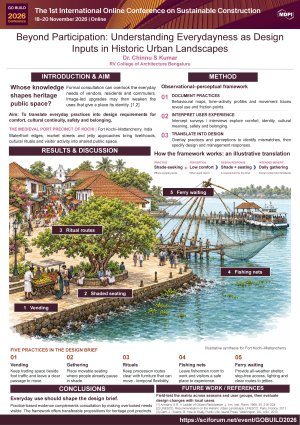
Placemaking in urban design often lays emphasis on the importance of community participation across varying hierarchies of engagement. However, such approaches chronically overlook everyday practices that shape the identity and character of a public space. The paper contends that the everydayness embedded in such patterns of gathering, movements, engagements or lingering, among locals, visitors, commuters, tourists or institutions, to negotiate space comprise a critical, yet underutilized form of end user engagement—particularly in heritage-rich public spaces.
To examine how everydayness informs place experience and design relevance, the research adopts a mixed-method approach. Drawing on the observational traditions of public life studies, the perceptual approach combines observational mapping, time activity profiling, movement place mapping, and user perception analysis in the historic port city of Fort Kochi, India. The analysis translates these everyday practises into context-sensitive design and management insights based on how spaces are collectively appropriated, negotiated and sustained over time.
The findings challenge generic waterfront upgrades and highlight the need for design interventions grounded in lived experience rather than abstract planning frameworks. The paper further demonstrates how documenting everydayness provides an empirical bridge between heritage significance and contemporary public space performance, supporting urban resilience through culturally responsive, socially inclusive, and context-sensitive design outcomes. While grounded in a historic port city context, the approach has broader relevance for designing public spaces in culturally layered historic urban environments.
Keywords
End-user-centric design
Community Participation
Placemaking
Everyday Practices
Sustainable Cultural Tourism
Poster
CSK_194752_S4_GO BUILD_2026.pdf
Material Supply Chain Disruption and Mitigation in Extreme Remote Construction: An Empirical Case Study from a Mining-Concession Infrastructure Project in Papua, Indonesia.
Assessing the Role of Fourth Industrial Revolution (4IR) Digital Technologies in Optimising Water Infrastructure Systems: Evidence from Gauteng Province, South Africa