Event submissions
Published
This submission belongs to the session 5. I – Innovate: Emerging Technologies for Sustainable Construction of the event The 1st International Online Conference on Sustainable Construction
Published date
13 Nov, 2026
Academic Editor
 Fanke Peng
Citation
Mahendra Samarawickrama, The Latency Proximity Paradox and the Social Geography of Future AI Data Centers: Implications for Sustainable Infrastructure Planning, in Proceedings of The 1st International Online Conference on Sustainable Construction, 18 November–20 November 2026, MDPI: Basel, Switzerland
Share
Email
Facebook
Twitter
LinkedIn
The Latency Proximity Paradox and the Social Geography of Future AI Data Centers: Implications for Sustainable Infrastructure Planning

Mahendra Samarawickrama 1
1. Sydney Program, Boston University (USA), Sydney, NSW, 2008, Australia
Abstract
Interactive artificial intelligence is moving from batch training towards continuous conversational and perceptual services, and that shift turns network latency into a constraint on where computing capacity may physically stand. Current data centre strategy favours remote campuses selected for cheap land, abundant power and few neighbours, while interactive workloads pull computation towards the households that consume them. This paper measures the collision between the two logics using open data. A July 2026 snapshot of round-trip times across 34 commercial cloud regions is combined with a published dataset covering 99 end-user devices and 490 infrastructure hosts, and with a public gazetteer of 7332 urban settlements holding 2.37 billion catalogued residents. Three findings are measured directly. Distance accounts for 78 percent of the variance in backbone round-trip time, at 15.5 ms per 1000 km. Measured paths run 1.80 times above the propagation limit of optical fibre. End-user paths are roughly 49 times more variable than infrastructure paths. Applying the measured stretch to budgets taken from published standards, namely 5 ms from ultra-reliable low-latency communication targets and 20 ms from motion-to-photon requirements for immersive applications, gives service radii near 283 and 1132 km. Inside those radii sit 22.8 and 64.6 percent of catalogued urban population, unevenly distributed, since 75.9 percent of urban Asia but only 22.8 percent of urban Africa lies within the 20 ms radius. Every statistic was independently re-derived through separate code paths. The planning implication, which the cross-sectional data supports rather than demonstrates, is that genuinely interactive services must be built near people, so siting pressure is likely to migrate into contested metropolitan fabric. Latency is one determinant among several, alongside grid capacity, water, land price and taxation, and it is the one that cannot be engineered away.
Keywords
data centres
edge computing
latency
AI infrastructure
sustainable infrastructure planning
Poster
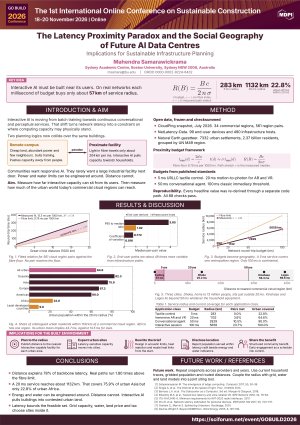
GOBUILD2026_Latency_Proximity_Poster_Mahendra_Samarawickrama.pdf
Addressing Data Scarcity in Offshore Wind CAPEX Forecasting: Regression-Based Approach
Modern Methods of Construction Adoption for Combating Productivity Challenges in Africa: A Systematic Review