Event submissions
Published
This submission belongs to the session 5. I – Innovate: Emerging Technologies for Sustainable Construction of the event The 1st International Online Conference on Sustainable Construction
Published date
13 Nov, 2026
Academic Editor
 Fanke Peng
Citation
Josep Ramon Lliso-Ferrando, Carlos Ortiz-Belmonte, Raúl Esteve-Jiménez, Manuel Valcuende, Untreated and Chemically Activated Recycled Glass Powder as a Partial Cement Replacement in Sustainable Concrete, in Proceedings of The 1st International Online Conference on Sustainable Construction, 18 November–20 November 2026, MDPI: Basel, Switzerland
Share
Email
Facebook
Twitter
LinkedIn
Untreated and Chemically Activated Recycled Glass Powder as a Partial Cement Replacement in Sustainable Concrete

Josep Ramon Lliso-Ferrando 1

Carlos Ortiz-Belmonte 2
Raúl Esteve-Jiménez 2
Manuel Valcuende 3
1. Research Institute for Molecular Recognition and Technological Development (IDM), Universitat Politècnica de València, Camino de Vera, s/n., 46022 Valencia, Spain
2. School of Architecture, Universitat Politècnica de València, Camino de Vera, s/n., 46022 Valencia, Spain
3. Department of Architectural Constructions, School of Architecture, Universitat Politècnica de València, Camino de Vera, s/n., 46022 Valencia, Spain
Abstract
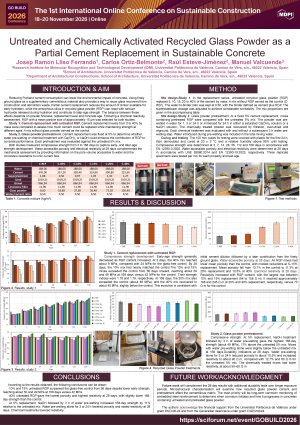
Reducing Portland cement consumption is essential to lower concrete’s environmental impact. Recycled glass powder from construction and demolition waste is a promising supplementary cementitious material due to its silica-rich composition and pozzolanic potential. However, its effectiveness depends on replacement level, curing age and chemical activation. This study evaluates untreated and chemically activated recycled glass powder as a partial cement replacement in sustainable concrete.
Concrete mixtures were prepared with 0–40% cement replacement by recycled glass powder. Untreated powder was compared with powders activated using calcium hydroxide and sodium hydroxide solutions under controlled immersion conditions. The experimental programme included compressive strength tests from early ages to six months, together with electrical resistivity and water-accessible porosity. The glass powder was also characterized through particle-size analysis, X-ray-based chemical/mineralogical assessment, microscopy and pozzolanic activity tests.
The reference concrete showed faster strength gain at early ages, confirming the dominant role of Portland cement hydration. However, concretes with moderate glass powder contents developed higher strength at later ages. Current results indicate that 10–15% replacement provides the best mechanical response, exceeding the reference concrete after prolonged curing. This trend is consistent with the delayed pozzolanic contribution of finely ground glass powder. Durability also improved, with increased electrical resistivity and reduced water-accessible porosity, suggesting microstructural densification and lower transport capacity. Preliminary activation results do not show a drastic improvement over untreated glass powder, although further tests are ongoing.
These findings support the circular use of recycled glass powder as a construction and demolition waste-derived material able to reduce cement demand while improving long-term concrete performance.
Keywords
Recycled glass powder
sustainable concrete
pozzolanic activity
construction and demolition waste
durability
Poster
Lliso_Ferrando_poster.pdf
Graph-Structured Generative AI for Regulatory Compliance in Heritage Planning: A Self-Supervised Evaluation over Japan's Statutory Rules
Bridging the Housing Prefabrication Gap: A Comparative Study of Project Management Practices in Australia, Sweden and Japan