Event submissions
Published
This submission belongs to the session 5. I – Innovate: Emerging Technologies for Sustainable Construction of the event The 1st International Online Conference on Sustainable Construction
Published date
13 Nov, 2026
Academic Editor
 Fanke Peng
Citation
Bem Gumapac, Sheilamae Simodlan Bersano, Robustness-Aware Explainable InceptionV3 for Concrete Crack Classification in Preliminary Infrastructure Conditions Assessment, in Proceedings of The 1st International Online Conference on Sustainable Construction, 18 November–20 November 2026, MDPI: Basel, Switzerland
Share
Email
Facebook
Twitter
LinkedIn
Robustness-Aware Explainable InceptionV3 for Concrete Crack Classification in Preliminary Infrastructure Conditions Assessment

Bem Gumapac 1

Sheilamae Simodlan Bersano 2
1. Computer Engineering Department, College of Engineering, Architecture and Industrial Design, Bohol Island State University, Tagbilaran City 6300, Philippines
2. Civil Engineering Department, College of Engineering, Architecture and Industrial Design, Bohol Island State University, Tagbilaran City 6300, Philippines
Abstract
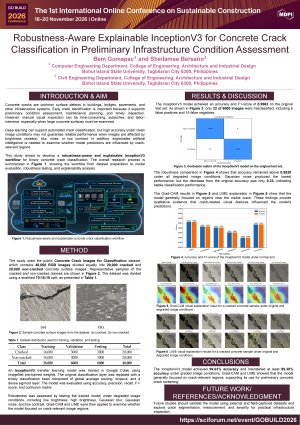
Concrete crack detection is an important component of preliminary infrastructure condition assessment because visible surface cracks may indicate early deterioration, maintenance needs, and possible safety concerns. Manual visual inspection remains useful in engineering practice, but it can be time-consuming, subjective, and labor-intensive, especially when large concrete surfaces must be examined. Automated crack classification using deep learning can support early visual screening and maintenance planning, aligning with SDG 9: Industry, Innovation and Infrastructure and SDG 11: Sustainable Cities and Communities through improved infrastructure monitoring and safer built environments. However, strong model accuracy under clean test conditions does not necessarily guarantee reliable performance when images are affected by poor lighting, blur noise, or reduced contrast. Interpretability is also important to determine whether model predictions are influenced by crack-relevant regions rather than unrelated surface textures. This study developed a robustness-aware and explainable InceptionV3 workflow for binary concrete crack classification using the public Concrete Crack Images for Classification dataset. The dataset consisted of 40,000 RGB images divided equally into cracked and non-cracked classes. Images were partitioned into training, validation, and testing sets using a stratified 70:15:15 split. InceptionV3 was trained using transfer learning with ImageNet pre-trained weights, a custom binary classification head, early stopping, and confusion matrix. Robustness was assessed by testing the trained model under simulated degraded image conditions, including low brightness, high brightness, Gaussian blur, Gaussian noise, and low contrast. Grad-CAM and LIME were applied to visually examine whether the classifier focused on crack-relevant image regions. The model achieved a baseline test accuracy and F1-score of 0.9963 on the original test set. Under degraded image conditions, accuracy remained above 0.9930, with Gaussian noise producing the lowest performance. Grad-CAM and LIME visualizations showed that the model focused on regions near visible cracks across normal and degraded images. The proposed workflow demonstrates strong potential as an explainable and robustness-aware preliminary screening tool for concrete classification. However, it does not replace professional structural inspection, crack measurement, or structural safety assessment.
Keywords
concrete crack classification
InceptionV3
robustness evaluation
explainable AI
Poster
GoBUILD2026_Poster.pdf
Surface-Domain Effects in the External Validation of a Mendeley-Trained CNN for Concrete Classification using SDNET2018
Industry-informed digital technology implementation framework for modular construction across lifecycle stages