Event submissions
Published
 10.3390/engproc2026163033 (registering DOI)
This submission belongs to the session S3. Sensor Networks, IoT, Smart Cities and Health Monitoring of the event The 13th International Electronic Conference on Sensors and Applications
Published date
13 Nov, 2026
Academic Editor
 Francisco Falcone
Citation
Oscar Andrés Tobar Rosero, Edwin Alexander Moncada Acevedo, Gabriel Jaime Sánchez Zuluaga, Manuel Alejandro Páez Frías, Johan O. Moreno-Castro, Low-Cost IoT Architecture for Remote Monitoring and SoH/SoC Estimation in Second-Life Batteries Using Sensor Networks, in Proceedings of The 13th International Electronic Conference on Sensors and Applications, 18 November–20 November 2026, MDPI: Basel, Switzerland, doi: 10.3390/engproc2026163033
Share
Email
Facebook
Twitter
LinkedIn
Low-Cost IoT Architecture for Remote Monitoring and SoH/SoC Estimation in Second-Life Batteries Using Sensor Networks

Oscar Andrés Tobar Rosero 1,2

Edwin Alexander Moncada Acevedo 1
Gabriel Jaime Sánchez Zuluaga 1
Manuel Alejandro Páez Frías 1
Johan O. Moreno-Castro 1
1. Facultad de Ingeniería, Institución Universitaria de Envigado—IUE, Carrera 27B # 39A Sur-57, Envigado 055420, Colombia
2. Departamento de Energía Eléctrica y Automática, Facultad de Minas, Universidad Nacional de Colombia Sede Medellín, Carrera 80 No. 65-223, Robledo, Medellín 050034, Colombia
Abstract
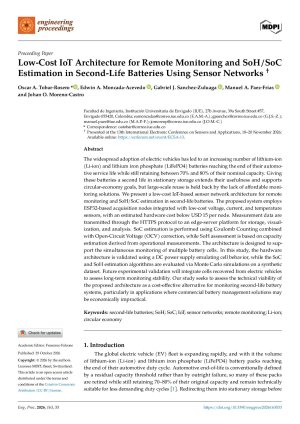
The widespread adoption of electric vehicles has led to an increasing number of lithium-ion (Li-ion) and lithium iron phosphate (LiFePO4) batteries reaching the end of their automotive service life while still retaining between 70% and 80% of their nominal capacity. Giving these batteries a second life in stationary storage extends their usefulness and supports circular-economy goals, but large-scale reuse is held back by the lack of affordable monitoring solutions.
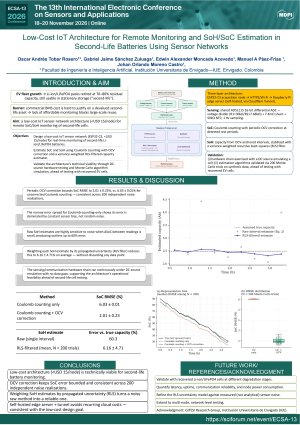
We present a low-cost IoT-based sensor network architecture for remote monitoring and SoH/SoC estimation in second-life batteries. The proposed system employs ESP32-based acquisition nodes integrated with low-cost voltage, current, and temperature sensors, with an estimated hardware cost below USD 15 per node. Measurement data are transmitted through the MQTT protocol to a cloud-based platform for storage, visualization, and analysis. SoC estimation is performed using Coulomb Counting combined with Open Circuit Voltage (OCV) correction, while SoH assessment is based on capacity estimation derived from operational measurements. The architecture is designed to support the simultaneous monitoring of multiple battery cells.
Experimental validation will be conducted using Li-ion and LiFePO4 cells recovered from electric vehicles at different stages of degradation. Performance evaluation will consider estimation accuracy, communication latency, and long-term monitoring stability. Our study seeks to assess the technical viability of the proposed architecture as a cost-effective alternative for monitoring second-life battery systems, particularly in applications where commercial battery management solutions may be economically impractical.
Keywords
second-life batteries
SoH
SoC
IoT
sensor networks
remote monitoring
Li-ion
LiFePO4
circular economy
Manuscript
Sciforum-196786engproc-163-00033.pdf
Poster
Batteries-poster-MDPI.pdf
UV-activated hybrid hierarchical ZnO/ZIF-8 gas sensor
Quantitative Evaluation of Background Noise in Acoustic Maps of Abrasive Grinding Wheels