Event submissions
Published
This submission belongs to the session 8. Cross-Cutting Theme: Building Science and Performance Innovations of the event The 1st International Online Conference on Sustainable Construction
Published date
13 Nov, 2026
Academic Editor
 Mehdi Amirkhani
Citation
Kabiru Timnan Sheni, Maryam Nahija Ibrahim, Oluwaseun Gabriel Olagunju, Multisensory Performance as a Building Science Parameter: A Post-Occupancy Evaluation of Sensory Congruence in Nigerian Hospitality Environments, in Proceedings of The 1st International Online Conference on Sustainable Construction, 18 November–20 November 2026, MDPI: Basel, Switzerland
Share
Email
Facebook
Twitter
LinkedIn
Multisensory Performance as a Building Science Parameter: A Post-Occupancy Evaluation of Sensory Congruence in Nigerian Hospitality Environments

Kabiru Timnan Sheni 1
Maryam Nahija Ibrahim 1
Oluwaseun Gabriel Olagunju 2
1. Department of Architecture, Ahmadu Bello University, Zaria, Nigeria
2. Department of Architecture, University of Jos, Jos, Nigeria
Abstract
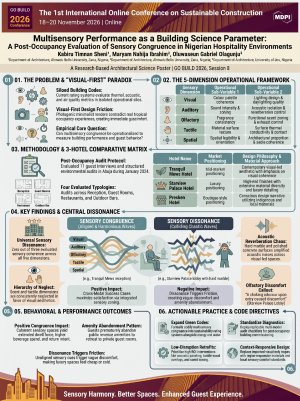
Introduction: Buildings are routinely assessed for thermal, acoustic, and energy performance, yet the multisensory coherence of interior environments remains scarce from mainstream building performance frameworks. Sensory dissonance, defined as the misalignment of visual, auditory, olfactory, tactile, and spatial design stimuli, constitutes a recurring source of occupant discomfort and dissatisfaction in hospitality environments. This study examines multisensory congruence as a measurable building performance parameter within the Nigerian hospitality context, where resort hotels are critical drivers of tourism and economic activity.
Methods: A qualitative multi-case study design was employed, drawing on structured observational assessments and semi-structured guest interviews conducted across three four-star hotels in Abuja, Nigeria: Tranquil Mews Hotel, Starview Palace Hotel, and Presken Hotel. Eleven adult guests were interviewed in January 2024. Data were collected across four focal spatial typologies per hotel, namely reception areas, guest rooms, restaurants, and outdoor bars, and analysed thematically against a framework of five sensory performance variables and their associated sub-variables.
Results: All three hotels exhibited significant sensory dissonance. Tactile and olfactory dimensions were the most consistently neglected across all case studies. Visual elements received the greatest design attention; however, the absence of crossmodal integration with acoustic and tactile conditions produced incoherent occupant experiences. Hotels demonstrating intentional sensory zoning and material-acoustic coherence recorded higher guest satisfaction and more favourable behavioural outcomes. Sensory dissonance was consistently linked to noise infiltration, inadequate daylighting management, and the absence of thematic material selection.
Conclusions: Multisensory congruence constitutes a legitimate and assessable dimension of building performance with direct implications for occupant wellbeing and behavioural outcomes in hospitality environments. Integrating sensory performance criteria into building assessment frameworks offers a practical pathway toward more human-centred sustainable design in the Global South.
Keywords
Multisensory congruence
sensory dissonance
post-occupancy evaluation
building performance
hospitality design
Poster
Multisensory_Building_Science_Research_Poster.pdf
A conceptual framework to optimize stormwater smart control combining IoT sensors and AI
Seasonal Indoor Comfort Evaluation for Residential Retrofitting Assessment