Event submissions
Published
 10.3390/engproc2026163035 (registering DOI)
This submission belongs to the session S5. Smart Agriculture Sensors of the event The 13th International Electronic Conference on Sensors and Applications
Published date
13 Nov, 2026
Academic Editor
 Stefano Mariani
Citation
ABDUL RASHEED, K Thangavel, M R Rajesh, Development of an Adaptive Grid-Based Soil pH Mapping and Lime Recommendation System, in Proceedings of The 13th International Electronic Conference on Sensors and Applications, 18 November–20 November 2026, MDPI: Basel, Switzerland, doi: 10.3390/engproc2026163035
Share
Email
Facebook
Twitter
LinkedIn
Development of an Adaptive Grid-Based Soil pH Mapping and Lime Recommendation System

ABDUL RASHEED 1,2
K Thangavel 1
M R Rajesh 1,3
1. Department of Electronics and Communication, Hindusthan College of Arts and Science, Coimbatore, India
2. Department of Electronics, WMO Arts and Science College, Muttil, Wayanad, India
3. Department of Electronics, Sree Narayana Guru College Chelannur, Kozhikode 673616, India
Abstract
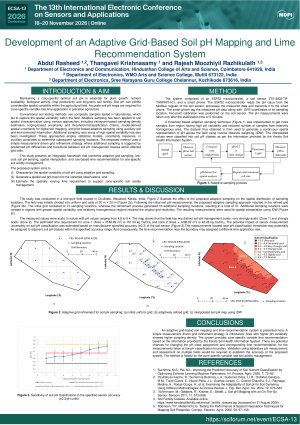
Maintaining optimum soil pH for specific crops is essential for improved nutrient intake and maximum yield. Conventional soil testing method uses composite samples tested in laboratory, which fails to capture the spatial variability within the field. This paper presents an adaptive grid-based soil pH mapping and rule-based, zone specific lime recommendation system. The system incorporates an ESP-32 based pH sensing node and a cell phone for fetching GPS coordinates and displaying map. Bluetooth communication is established between microcontroller and cell phone. The pH sensor is calibrated using laboratory results for improved measurement accuracy. Median filtering with averaging is used to eliminate sensor noise. An adaptive grid sampling is implemented, so that greater number of samples are taken from regions having high pH variability and reduced number of samples in relatively homogenous area. The calibrated pH measurements are used to generate a spatial map with interpolation technique. Based on the soil pH and agricultural recommendations, the system estimates zone specific lime requirement for the field. This approach suggests a variable lime rate application for different zones of the field and reduces the unnecessary lime usage. The proposed system aims at providing a cost-effective alternative to the conventional technique, suitable for precision agricultural application.
Keywords
soil pH mapping
adaptive grid
lime recommendation
precision farming
Manuscript
Sciforum-192531engproc-163-00035.pdf
Poster
Poster Abdul.pdf
Quantitative Evaluation of Background Noise in Acoustic Maps of Abrasive Grinding Wheels
SpectraNode: An Embedded TinyML Platform for Autonomous Nonlinear Spectral Correction in Controlled-Environment Agriculture