Event submissions
Published
 10.3390/engproc2026163036 (registering DOI)
This submission belongs to the session S4. Sensors and Artificial Intelligence of the event The 13th International Electronic Conference on Sensors and Applications
Published date
13 Nov, 2026
Academic Editor
 Francisco Falcone
Citation
Juan Morales-Guerra, Erick Reyes-Vera, Kevin Henao-Gómez, Juan Zapata-Londoño, Juan Sebastián Botero Valencia, SpectraNode: An Embedded TinyML Platform for Autonomous Nonlinear Spectral Correction in Controlled-Environment Agriculture, in Proceedings of The 13th International Electronic Conference on Sensors and Applications, 18 November–20 November 2026, MDPI: Basel, Switzerland, doi: 10.3390/engproc2026163036
Share
Email
Facebook
Twitter
LinkedIn
SpectraNode: An Embedded TinyML Platform for Autonomous Nonlinear Spectral Correction in Controlled-Environment Agriculture

Juan Morales-Guerra 1

Erick Reyes-Vera 2
Kevin Henao-Gómez 1
Juan Zapata-Londoño 3
Juan Sebastián Botero Valencia 4
1. Department of Systems, Institución Universitaria ITM, Medellín, Colombia.
2. Department of Electronics and Telecommunications, Institucion Universitaria ITM, Medellín, Colombia
3. Faculty of Engineering, GITESI Research Group, Institución Universitaria de Envigado, Envigado 055420, Colombia
4. Department of Mecatronica, Institución Universitaria ITM, Medellín, Colombia
Abstract
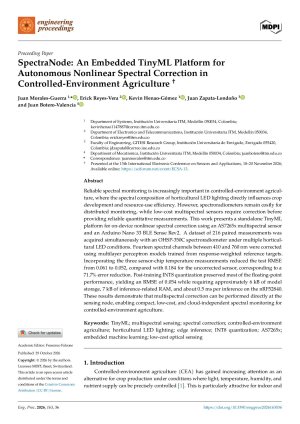
SpectraNode is a low-cost embedded prototype designed for autonomous real-time spectral correction in sensor nodes for controlled-environment agriculture. The system acquires spectral measurements at fixed monitoring points within horticultural LED-lit growing facilities, delivering more reliable spectral data without dependence on network infrastructure or external processing.
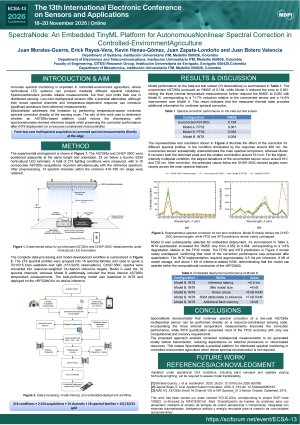
The prototype integrates an AS7265x 18-channel multispectral sensor (410–940 nm) connected via I²C to an Arduino Nano 33 BLE Sense Rev2 with an ARM Cortex-M4F microcontroller (nRF52840, 64 MHz, 256 KB SRAM). The system pipeline includes: acquisition of 18 raw spectral band values, on-device normalization, inference through an 8-bit quantized multilayer perceptron (MLP) running on TensorFlow Lite Micro, and wireless transmission of the 18 corrected spectral values via BLE 5.0 to an Android application for real-time visualization and field data export. The MLP architecture consists of three hidden layers with 64, 32, and 16 neurons using ELU activation and an 18-neuron linear output layer covering the full spectral range (410–940 nm). The model occupies approximately 10–16 kB, under 7% of available SRAM, allowing fully standalone operation without network connectivity.
The model was validated against a commercial spectroradiometer (OHSP-350C) under horticultural LED lighting conditions representative of controlled-environment agriculture. A linear regression baseline trained on the same data reduced the normalized RMSE by 45%. The proposed embedded MLP achieved an 80% RMSE reduction, outperforming the linear baseline. Inference latency on the Cortex-M4F confirmed real-time operation, with a memory footprint below 7% of available SRAM.
To the best of the authors' knowledge, this is the first system to combine on-device nonlinear spectral correction with BLE 5.0 transmission to a mobile Android application on a standalone Cortex-M4F node for controlled-environment agriculture, in contrast to prior work that depends on Wi-Fi connectivity and server-side processing. Future work will address on-device spectral drift detection and adaptive retraining under varying lighting conditions and sensor aging.
Keywords
TinyML
multispectral sensors
spectral correction
edge inference
TensorFlow Lite Micro
low-cost sensing
controlled-environment agriculture
precision agriculture.
Manuscript
Sciforum-191829engproc-163-00036.pdf
Poster
Poster Morales_ERV&Zapata.pdf
Development of an Adaptive Grid-Based Soil pH Mapping and Lime Recommendation System
Closed-Loop Water Recirculation and IoT-Based Monitoring System for Aeroponic Cultivation